
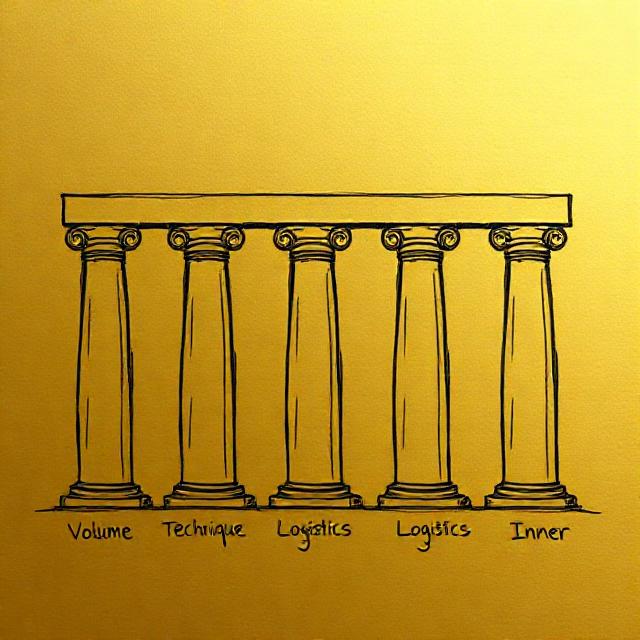
Daygame is multi-variate. There is not a single factor that makes someone succeed at Daygame; it is always a combination. The picture gets even more confusing when we acknowledge that we don’t even control most of the factors that lead to success. In a sense, the girl’s openness to seduction is determined more by the girl than the Player.
However, there is a small subset of controllable factors. Some have claimed it is at most 20% of the outcome. Small as it may sound, over a long timescale, it is enough to make a difference. This subset is what we call the Daygame skillset. It is not enough to guarantee success by itself, but it is the extent of the things we can control.
What does this skillset consist of? This has caused much confusion in the community because unfocused effort is both wasted and, many times, counterproductive. We aim to answer this question precisely. The Daygame skillset is comprised by five pillars:
- Volume
- Value
- Inner Game
- Logistics
- Technique
All of these are equally important and equally relevant for our success in the field. A Player needs all of them for consistent results. One won’t cut it, two won’t cut it. It is all or nothing. Seduction is “winner takes all” because of the laws of hypergamy. If we want to get precise, as a heuristic, I would say that missing one makes it exponentially harder, and missing two makes it nearly impossible to get a Daygame lay. This begs a deeper question: what is Daygame actually aiming at?
Sustainable Success
A discussion is required here. Sure, the skillset exists, but what does success mean? Is it unlimited access to quality girls for life? That would be ideal, but it is unrealistic. Instead, what we aim for is “sustainable success”, meaning success that is repeatable, but not purely mechanical or endlessly scalable. Let’s understand this with an example. We all have a chode friend. He goes out one day, gets drunk, finds another drunk girl, and scores a one-night stand. Nice, success! But… something is missing.
It is replicability; what he did is not systematised and cannot be repeated with statistical confidence. Our friend in question is susceptible to the whims of luck both in acquisition (finding his one-night stand) and his retention (maintaining and keeping the girl).
Daygame is not like that. Daygame has a clear structure and input/output guidelines. Eventually, a seasoned player knows how much effort he needs to put in to find a girl, whether measured in number of sets (e.g., 30–60) or time spent (e.g., 1–2 weeks). This makes all the difference from the lucky one-night stand our chode friend got earlier. This is specifically why learning Game is worth it.
However, even Daygame is not infinitely repeatable. Because our value is an equation that involves our vibe, we will eventually hit diminishing returns. Opening carries an emotional cost; it is a catabolic action, and inevitably, our vibe diminishes to a point where nothing is achievable except taking a break and focusing on other areas of life for a bit. This predictability, but not infinite scalability, is precisely what sustainable success means. It is the extent we can push the limits while still staying “human”. Let us now analyze each category.
Volume
As a definition, volume is self-explanatory. It is the amount of infield work. The realistic unit of measurement is “sets”. Anything after opening (texts, dates, etc.) is calibrated to the girl and distorts the purpose.
Its function is purely probabilistic. Simply put, we are increasing the sampling size to make results predictable; it is the law of large numbers in action. It is especially pivotal when testing and introducing a new theory. A model change is not measurable in 10 sets, but very measurable in 100 sets for its impact and utility. Hence, your skill and proficiency in Game cannot be guaranteed without that bedrock of volume.
Calibration
With that being said, here is the caveat. Do we need a big Volume to get success from Daygame? Absolutely not. With calibration and patience, a trained Daygamer can gauge the probabilities of successful sets pretty accurately.
This, however, distorts the purpose of Game. It carries a heavy cost in time (to find such a girl), in learning potential (by definition, you are opening within your comfort zone), and in quality (the higher you go, the more Maybe girls we get). Therefore, a low volume/high calibration strategy is not recommended.
Additionally, even at advanced stages where players are expected to have reached the limits of calibration, the calibration itself has its own limitations. It is one thing to be able to predict if a girl will be open to being approached or give her number, and a totally different thing to be able to predict if a girl will sleep with you. Calibration can never fully replace infield work.
Value
Now, if one thing is elusive to define, it is value. Simply put, Value is the abstract collection of traits that make us attractive to the ladies. Canonically, that is its definition. Let us defend this and connect it with the Red Pill definitions of value.
Red Pill has adopted many economic terms that, at first glance, contradict our definition. We all have heard about “Alpha is a value-giver” or “give value to your community”. My answer: those things wouldn’t exist if they didn’t also increase our chances of getting laid. Sexual and economic value go hand in hand, evolutionary speaking. This is proven by contraposition: any form of value production that doesn’t increase your chances of passing on your genes increases your rival’s.
Value in Daygame
We have a working definition, but it is still quite abstract. Especially so when applied to Daygame. If value is anything that girls like, how do we quantify and use it?
We are lucky because Daygame itself is limited in the scope of its value proposition. By construction, Daygame only cares about specific aspects of Value. This makes things workable. Value defined within the context of Daygame boils down to three categories:
- Looks: which further breaks down to genetics (height, symmetry, testo, etc.), researchable/planned (fashion), and built (gym).
- Charismatic: essentially, how we capture the attention and admiration of strangers. It is heavily reliant on education (provide specialised input), wit/vibe (provide intriguing input), and experience (provide applicable input).
- Archetype: this is an amplification of Value by coherent life choices. Essentially, achieving more than the sum of individual parts. For example, the cowboy archetype is much more than the hat, boots, and horse, because the cowboy lifestyle means so much more. However, when a stranger sees the hat, horse, and boots, they will naturally infer the other traits without requiring demonstration.
Inner Game
Inner Game is pretty complex. On the surface, why should there be any need for it? Daygame has a concrete theory and a clear timeline for improvement. Then why do so many people who pick it up fail and abandon it soon after? There is a clear mismatch between progression in reality and progression in theory.
Inner Game serves as an inner toolkit of the psyche to withstand typical infield pressure. It breaks down into four categories.
It is the ability to withstand adversity
Daygame has a brutal learning curve; there is no denying it. The beginner will usually have to withstand hundreds of sets before he finally sees success. It takes a certain personality that can withstand this pressure.
But even at advanced levels, the issue persists. I remember a day that out of 7 sets, 5 were among the harshest blowouts I had ever gotten, 1 was an instant date with an eight (sadly to nowhere), and 1 was a SDL with a seven. It sounds like success, but out of a 5-hour session, I still had to deal with failure 90% of the time. To nail the point, I remind the community anecdote about Tom Torrero. Supposedly, he had gotten 14 harsh blowouts in a row before the 15th set escalating into an SDL.
The ability to project your Being into the world
Seduction just doesn’t work unless you fully believe in it. Deep down, seduction is character and ID-driven. At this deep level, it is impossible to fake things. It is a place where pretending doesn’t protect us, and Ego delusions don’t protect us. A parallel is negotiating a salary with your boss. Much of your success depends on believing you deserve the raise. You have to have your inner world set, so you can project it outwards.
Humans have evolved to sniff out inconsistencies from a mile away. Girls doubly so, because their genetic descendants rely on her ability to choose a male with good genes. Therefore, it becomes really hard to express Value we don’t truly have. To narrate stories we haven’t really lived. To pass shit-tests only on words. Frame, specifically, is controlled via emotions and non-verbals much more than verbals.
The ability to reinvent yourself
Seduction is not a magic pill. It is very grounded in science. Scientifically, there is indeed a type of man who gets laid. There are actually many of those types; there is significant leeway and wiggle room. This is good for us; otherwise, we would have to resort to fatalism.
However, when starting your journey, you are not any of those yet. You don’t even know which one you will end up being. You will have to break down habits and re-examine everything that you hold dear. Eventually, you will have dug so deep to discover your immovable true core, and this is where your purpose will start to make sense.
Then we are still not done, you have to consolidate your inner discoveries with your outward persona. What is broken must be rebuilt. This takes courage and experimentation. Not many people have this capacity for self-reflection. It is very, very hard. Every part of your being will be resisting you all the way. But it is possible, and it is worth it.
The ability to charter your course
When we are introduced into this community, when we step out of the Matrix, all the orderly delusions of the world break down. This was the one benefit of staying plugged in; it was comfortable, but now it is not anymore. We need to keep going; we cannot stay paralysed without moving. We need to chart a course on uncertain grounds. It feels like walking blindfolded on a tightrope. This is not easy. We have been given agency, and that agency comes with a specific proposition:
We are free to make choices, total freedom, but we have to learn to accept the consequences of our own actions.
Some people can thrive on this; some people need to learn how to thrive. For naturally high agency people, this is the default mode. For the others, they will have to learn to adapt.
Logistics
Logistics is usually defined as “having accommodation” in a convenient place. For much of the time, this is enough, but it gets deeper. Logistics is about our high-level plan of seduction. It is the way we structure our choices and the tradeoffs we consciously choose to undertake. Here is an analogy:
You want to run a marathon. One track goes through a Mesa, which is mostly flat, but isolated. No phone signal, no access to supplies, and hard to get assistance in an emergency. The other track goes between two cities, you will pass through shops, but it also has significant sections with hills, and you will need more energy to undertake them.
If we are optimizing for speed, the Mesa track is the best choice. It is flat with few distractions. But it provides no leeway; any emergency will significantly endanger your life. This doesn’t make it unviable by itself. For example, you can always hire a team to keep pace with you in a supporting track, or you might be so experienced that you can take the risk. But the whole point is: it has to be a conscious trade-off that you can plan and play off from.
Logistics means mapping the area and charting your path knowingly. The advice a newbie should take on the Mesa track is objectively bad. Not because he might not pull it off, but because he cannot plan for it.
Strategic Daygame
Back to Daygame now. We can see that some Logistic advice is objectively better than others. For example city-center apartment vs the suburbs.
This is good, but what is more important, especially for the beginner, is to know why. For example, a city-center apartment can accommodate a first date lay, while living further might require two. There is a bunch of extra variance introduced from the downtime between the dates, hence city-center beats the suburbs.
The contrary is also true. If you have a suburban apartment, the fact that you probably need two dates (excluding outliers and high-interest girls) should make you restructure your date plan. This knowledge/ability to deal with logistics is as important as having the city-center apartment itself.
Technique
Technique is the learnable/teachable part of Game. If you can explain it, then it is part of Technique. Importantly, this includes calibration.
Let’s leave calibration aside for now and discuss Daygame Technique. Thankfully, it is really simple. Once we learn how to open, handle a set, and lead through the dating process, there isn’t much else. This is a positive of Daygame, over, let’s say, Social Circle Game, where we need a how-to for handling large groups of people. Pick any Daygame textbook, and you can be done with this part.
What is certainly less easy to learn is calibration. But… Why is even calibration part of Technique? Plain and simple, we can always explain when we do something based on calibration. Calibration says: “I noticed that, so I adjusted that way”. For example, manners are a form of calibration (cultural form), and there certainly are manuals on manners. The whole point is that calibration is learnable.
In our case, seduction calibration, is mostly taught infield the hard way. There is simply no substitute for learning and reading signals and body language except hands-on experience. The saving grace is that, albeit hard, there is a clear path to learning Technique: practice, lots of it.
Infield or no Infield
This is where newbies need to be especially careful. When we are talking about learning Daygame, we obviously need to practice. But we do infield work for specifically two goals that we shouldn’t confuse:
- To get results
- To learn/practice technique.
Things collapse when number 2 doesn’t directly lead to number 1. This is a big paradox, right?
As we discussed in the beginning, to be in number 1 mode, we need mastery over all 5 pillars. However, only Technique is directly practiced infield. The other pillars take input from infield practice, but need to be addressed also outside of the field. We cannot solve Inner Game infield, we cannot solve Logistics infield.
That is why the newbie needs to do enough infield work to practice Technique, but then needs to moderate it to allow work on the other pillars. Throwing yourself into set after set, after some point, won’t help you on its own.


