
Site Map

Read the book

Substack | Twitter

Author: Coffee daygame

  • Where are we? – Gender dynamics into perspective

    Where are we? – Gender dynamics into perspective

    There is something about Civilization writers. Think of Spengler, Quigley, or Amaury de Riencourt. These are macro-level thinkers with unusual synthesizing power. They managed to discover societal patterns that play over centuries and have repeated time and time again. 

    We can apply their logic to uncover truths about our society. Our era has shocking psychological parallels with societies past. The building blocks of human psychology don’t change, so the structures built from them tend to converge into recurring forms. There are only so many ways a society can structure itself. That is the mechanism that connects history and society.

    Which leads to the biggest lie Modernity tells to itself. The myth of continuous progress. The claim is very true in terms of technological advancements, but very false when it comes to the sociological and psychological status quo. This is expressed nowhere more clearly than in gender dynamics. Structurally, how genders interact with each other is the core of society’s psychological battlefield. 

    This may sound far-fetched, but at the center of every society and every political system lies the question: Who should get power and status? This is where politics and gender dynamics become one, because for humans, power and status are simply breeding rights. It always has been that way and always will be. The political battlefield is the mating battlefield itself.

    Hence, this is the full mechanism: 

    • Macro historical patterns guide societal psychology.
    • Psychology guides politics.
    • Politics is the same as gender dynamics.
    • As history repeats, the cycle repeats

    Again and again ad infinitum. Nothing in the modern gender dynamics is new. The scale and the impact are unprecedented due to technology, but the drivers remain the same. To understand why this mechanism exists, we need to start at the largest possible scale: the rise and fall of Civilizations themselves.


    Basics of Civilization analysis

    So what is a Civilization? There are different answers to this question. Some more formal, some less. For our purposes, Civilization means a “way of life”. 

    A way of life is certainly not a static principle. As all things in nature do, it destabilizes through time from the principles of entropy. Therefore, Civilizations are not fixed objects; they exist and eventually do not exist or dissolve. This blurs our definition because we are trying to make categories out of a continuum. But on a macro scale, the lines are visible. Here are some clarity examples:

    • Ancient Greece and Ancient Rome – Different but structurally similar.
    • Ancient Rome and Modern West – Totally different.
    • Medieval Europe and the West – Similar (Christian core and outlook, for example).
    • Ancient Egypt and Ancient Greece – Totally different.

    These are true structural differences in space and time that we cannot ignore. If these differences exist, then they must originate from somewhere. This implies some yet undefined birth mechanism for Civilizations.

    We also have the next hint: Ancient Egypt is not alive today. It rose and eventually collapsed. We even know when it collapsed: it was conquered by Alexander the Great. The same is true for the Classical Era (Greece + Rome), the Chinese empire (before communism), the Japanese empire (before WWII), etc. All these “ways of life” don’t exist anymore. Therefore, a mechanism for decay must also exist. 

    This beginning-to-end observation is what gives rise to what is called a “civilization cycle”. It studies exactly this and gives a name to the undefined mechanisms we observed above.


    The Civilization Cycle

    The steps between rise and collapse have been studied by historians, and the basic structure is presented below:

    Formation → Expansion → Crystallization → Decline → Collapse

    Each writer varies this structure to present their own model. For example, Spengler has the Culture-Civilisation contrast, and Quiggley has a 7-step process. But the five meta-steps presented above stay consistent. It is not within our scope to get into detail on the historical drivers that give rise to these cycles. However, we have enough information to get an idea of the society’s psychology. Each phase has its own cultural and environmental challenges. During the formation stage, people seek a unifying identity. During expansion, abundant resources give a sense of superiority, arrogance, and positivity. During the decline, entrenched interests paralyze the society. 

    We can then classify the West by examining its traits. Pick your Civilization model, and you can analyze each stage at different resolutions and accuracy. But there are points of agreement: The rationalism, i.e., the avoidance of empirical data (e.g., blank slate), the urbanization, and the cultural stagnation that are rampant today are traits of Civilizations in decline. 

    The modern West, is a Civilization in decline. Our social institutions are collapsing, our morals don’t hold up to reality, and the psychological strain on the citizens is immense and visible. However, these variables discussed – our philosophies, social forces, and outlook – have nothing new compared to societies past. This is a historical fact. And this historical fact leaves the question: Why does this happen? 

    We have a deeper question, so we need to dig even further into Civilization psychology to get an answer. Nobody nailed this answer except Amaury de Riencourt.


    Amaury de Riencourt, the unifying force

    Riencourt managed to analyze societies by assigning them a collective psychology, not unlike the Jungian collective unconscious. Riencourt’s book Women and Power in History has the following thesis:

    • There is a Female spirit and a Masculine spirit. These are psychological archetypes deep in the human soul.
    • In every era of history, one has the edge over the other. This creates the historical cycles.

    Riencourt talks about Masculine and Feminine in the psyche, not men and women. Something more fundamental. These are psychological archetypes that exist in all humans. 

    A useful parallel is the concept of a warrior spirit. All warriors are distinct humans, so they are different. However, at a macro level, the psychosynthesis of all warriors is similar: they have to overcome an opposing force, with courage, strength, persistence, and ingenuity. This grouping allows us to study them as a single psychological entity. Our grouping of Male and Female psychology works similarly. 

    The gendered terms come because these psychological archetypes emerged from the outlook of each gender. Each gender has fundamentally different brain chemistry and a different societal reception. The schism is deep enough to define completely different challenges and objectives for each gender. Collectively, these create the different outlooks and, at a macro level, define the Male and Female psychology. The traits of each are explained in detail on the Origins of Blue Pill blogpost in detail. A short version of each gender’s biases in the psyche is as follows:

    • Female Spirit: Cyclicality, Lives in the now, Has purpose from nature.
    • Male Spirit: Logical, Needs to create purpose, Linear in time.

    These deeply antithetical viewpoints cannot co-exist. Society is stratified in eras when one or the other prevails. When the Male or the Female spirit prevails, it imposes its psychosynthesis into the society’s software. The archetypes themselves become the psychological archetypes of the society. This creates some predictable societal forces that will be analyzed below.

    Male Spirit Prevalence

    The Male spirit arises from a need for “progress”. It arises from scarcity in resources or in the psyche; this is a calling to face the world. It aims to battle and conquer nature. A society adopts variations of the following traits:

    • A Warrior-Aristocratic social order: martial values, loyalties, hierarchies.
    • Collective identity over individual autonomy
    • Fertility is a Civilizational priority because of armies and colonial expansion; they need more people.
    • Marriage is functional and stable: sometimes arranged and economically driven.
    • Low social mobility for women: family and kinship dominance.
    • Cultural output: monumental, purpose-driven: think Philosophy, the Protestant Reformation, and Science.

    Here are examples of such societies: Archaic Greece, Early Rome (Republic), Qin/Han China, Early Islamic Caliphate, Early Medieval Europe. Different Eras and cultures, but the same macro-level psychological forces were present in all of them.

    Female Spirit Prevalence

    Arises from stabilization and safety. The Feminine Spirit emerges when external constraints diminish. What happens to drive it into power?

    Wealth increases, large cities increase. Security replaces danger, armies professionalize and become secondary. Bureaucracy centralizes power, the society becomes collective. Finally, kinship networks weaken, and people become detached from their roots and geographically mobile.

    These are not random. These are natural female traits. Collectivization, female flight, and a shift from hard to soft power are textbook evolutionary psychology. This is the female evolutionary strategy enveloping the psychology of the society. Women gain social visibility and psychological authority from this, though not always political power. These patterns are extremely predictable for any Female Spirit Era. All these societies had them: Hellenistic Greece, late Rome, Tang China, Heian Japan, Enlightenment France, Weimar Germany, and the Modern West. Riencourt just gave them a psychology. He took societal data and put them in a psychological framework that is predictable. Let us see this psychology in action that he theorized:

    • A cosmopolitan, commercial social order: power through wealth and money prevalence.
    • Individual autonomy over collective duty: personal fulfillment becomes central.
    • Fertility declines sharply: urban women reproduce less, and men prioritize lifestyle. (Ring any bells?)
    • Marriage becomes fluid: divorce rises, and so does remarriage.
    • Women gain cultural, moral, and social influence: they dominate culture, whether in early salons or late HR departments and academia.
    • Cultural output: aesthetic and theatrical, but lacks meaning.

    Our current society embraces and celebrates exactly all of these. In particular, it shames and mocks exactly all the traits in the Masculine section. We showcase by example, we compare our modern era to its closest parallel, the Late Roman Empire. 


    Western culture is the culture of the Late Roman Empire

    West and Late Rome are both deeply Female societies. In particular, they became deeply Female after a deeply Masculine phase. That is the source of commonalities, and the parallels are staggering:

    The decline of elite masculinity

    Rome: soldier → bureaucrat.

    Modern: frontier explorer → manager/technocrat.

    Rising influence of women

    Rome: cults, households, patronage.

    Modern: HR, education, therapy, social media, moral discourse.

    Fertility collapse

    Rome: elites avoided children to maintain their lifestyle.

    Modern: same dynamic.

    Individualism over collective duty

    Rome: civic virtue → self-preservation and luxury.

    Modern: same pattern.

    Decline of marriage as a structural institution

    Rome: numerous legal reforms attempted, all failed.

    Modern: same.

    Sexual-market elite concentration

    Rome: elite men monopolized female attention.

    Modern: open hypergamy.

    A cultural shift from martial virtue to self-preservation

    Rome: citizen-soldier ethos disappears.

    Modern: risk-taking minimized; safetyism dominates.


    I don’t want readers to read passively. I challenge everyone to fact-check the above claims. Both Rome then and the modern West now show the same social pattern shifts.

    This force that brought these changes is what Riencourt calls the Female archetype. It is also exactly the Feminine Imperative that Rollo Tomassi waxes lyrical about. Riencourt’s Female archetype is the macro-level equivalent of what the Manosphere calls the Feminine Imperative. It is not a conspiracy; it is a Civilization pattern. It is predictable, and it has a mechanism.


    Ideology Normality Cohesion

    Let us now investigate how societies get trapped in a certain psychological state and become self-preaching to paranoid levels.  We trace the full roadmap from psyche to ideology to entrapment.

    Ideology emerges from a society’s collective psyche. For example, nobody disputes the myriad blessings of Christianity (eg, positive outlook, epistemology, and open-mindedness), but Christianity is a Female religion: It is forgiving, open-minded, and pacifist. It was adopted because the Late Roman Empire was Female in psyche. In contrast, it could have never adopted Islam (a Male religion), for example. Only compatible concepts can be adopted and celebrated.  Similarly, in the West, the psychology is Female. This psychology is the framework of our Civilization’s ideology. Ideology comes from the collective soul, and once that is set, it cannot change (without changing the soul again). 

    A set ideology is not ideology anymore; it is normality. People stop second-guessing their deepest assumptions. For the participants, these are the rules of the world now. Ideology has become reality itself. The social institutions serve the people, so they serve this normality. They must reflect the dominant worldview to survive. The collective soul is fixed, and the only concern is cohesion. They become cohesion engines because their legitimacy depends on enforcing the normalized values. 

    This completes the circle. Our current society has a Female psychology. The ideology of this Female psychology is expressed exactly the way Riencourt predicted. Exactly the same way it was expressed in Late Rome. The change to Female worldview happened during the sexual revolution. From then on, we have settled into normality. The society and its institutions, then, become a vehicle to preserve this normality.

    This leads to a unique insight. The institutions that the modern manosphere blames are not a cabal or a conspiracy. They are doing their job as intended. They are making society cohesive. They are maintaining the psychological equilibrium. Here are examples:

    • Modern therapy: the goal is to push people into normality. The normality is Female nature.
    • HR departments: same function as therapy, but for the business world. 
    • Universities: Science is the manifestation of Philosophical metaphysics. Before the idea gets verified, the idea needs to exist. The modern avoidance mechanism is ultra-specialisation: Ignore the problem by refusing synthetic thought. This is already an adaptation above other similar-era institutions. Think of priestly schools, Confucian scholars, etc.
    • Law: similar to universities. The law has to serve what is considered fair in a society. With this viewpoint, the Western law does its job correctly.

    These are not independent phenomena; they are the predictable behaviors of institutions in any era where a Spirit dominates. The society technically works as intended. The problems the Manosphere has identified are emergent and systematic from historical cycles.


    Essay extras

    Extra I — Post Script: Author’s Notes

    This essay is not written to view the world as deterministic and resort to nihilism. We indeed uncovered some of the deep secrets that rule our world, but notice the difference: once the structure is visible, it stops being personal!

    A known system can be manipulated to our advantage. A personal feud cannot. Neuroscience backs this up completely; living objects and non-living objects are processed in different parts of the brain. Make the switch. Start seeing society as a mechanism, not as something personal. This will allow you to spread your wings and grow.


    Extra II — A Case Study: Divorce

    To nail the point, no other social institution proves our main thesis than divorce itself. Every Female society had similar divorce norms as now. The only difference is the intensity with which they are enforced now. Take it away:

    Late Classical Athens (4th century BCE)

    Hetairai (courtesans) gained cultural influence.

    Marriage norms:

    •Divorce was easy for men and tolerated for women.

    •Affairs with hetairai were common.

    •Male investment in the household declined; extramarital life increased.

    Hellenistic Egypt (Ptolemaic period)

    Women could own property, run businesses, and sign contracts.

    Marriage norms:

    •Divorce was equally accessible to both sexes.

    •Adultery laws existed but were inconsistently enforced.

    •Serial marriages were common in cosmopolitan urban centers like Alexandria.

    Late Republican & Early Imperial Rome

    Elite Roman women gained mobility, education, and property rights. They also had political and religious roles (e.g., Livia, Agrippina).

    Marriage norms:

    •Divorce was easy and common for both sexes.

    •Adultery became a normal social behavior.

    •Serial marriage was widespread.

    Tang Dynasty China (7th–9th century AD)

    Women rode horses, played polo, and traveled freely. Urban commercial women had property rights.

    Marriage norms:

    •Women initiated divorce at historically high rates.

    •Urban elite women engaged in serial partnerships.

    •Concubinage and extramarital affairs were accepted.

    •Marriage was seen as companionate instead of a duty.

    Courtly Love Era (12th-13th century AD)

    Noblewomen were cultural focal points. Literary and social life centered on feminine aesthetic ideals.

    Marriage norms:

    •Extramarital romantic relationships became celebrated.

    •It was embedded in culture as courtly love.

    •Female choice in romantic affairs increased.

    Enlightenment France (18th century AD)

    Salons run by aristocratic women shaped political and intellectual life. Women influenced taste, literature, and social norms.

    Marriage norms:

    •After the Revolution, divorce became legal and surged.

    •Affairs were nearly universal among the nobility.

    •Divorce was illegal earlier, but practical separation and serial affairs were socially normalized.

    The Modern West (1960s–present)

    Public, cultural, and moral authority shifted heavily towards women.

    Marriage norms:

    •No-fault divorce.

    •Serial monogamy.

    •Normalized affairs.

    •Online dating leads to fluid partner selection.


    The only difference in our era from the historical past is the severity of enforcement. Enforcement today feels so unfair because it is amplified by technology and state power. Everything else has played out exactly as it did in the past.

    Hard to digest, huh? Manosphere indeed needs a strong stomach

  • Why Daygame Works

    Why Daygame Works

    Every person who comes into Daygame has this question. Even advanced Players have it. We know it works, but why should it ever work?

    The first reaction of a person hearing about Daygame is along the lines, “So, did you get slapped?”. This is a huge mismatch between perception and reality. Daygame is not magic by any means; it is very grounded in science, actually, but for this person, this person who makes this comment, it is magic. 

    This is the point of this essay: to analyze exactly this question based on biology, sociology, and the proposition of Daygame.


    The Stop: the Miracle

    The invention of Daygame comes at the end of the evolution of Game. Game started as routines and gimmicks, and most importantly, Indirect. Later on, people started discovering that the routines and the gimmicks weren’t the ones getting them laid; their delivery, character, and value were. This led to the discovery of Direct Game: drop the scripted lines and work on the things that matter. 

    Daygame sits at the top of the pyramid of Direct Game. We are stripping seduction to its most essential parts; we don’t need an excuse to open anymore. This freedom and independence are two of the main draws to its practitioners.

    Daygame starts when the Player runs to the girl, and she stops to listen to him. The vast majority of girls will not give you this option; they will blow you off immediately. That is okay, because a minority will stick around. Game is not about getting every girl; it is about increasing the chances of finding girls who will give us a chance.

    This is the true magic trick: getting a stranger to listen to your pitch. This is where skill begins. This is where behavior can become predictable over large samples. Hence, the question of “Why Daygame works?” reduces to why the stop works.


    Sociology Behind Daygame

    Daygame and cold approaches in general (for example, sales, business) can only work when certain sociological conditions exist. In nature, humans are highly tribal. Most sociologists and primatologists can’t agree whether humans are monogamous or not, or whether humans are egalitarian or hierarchical, but they can agree on this: humans are clan-first and closed-minded. 

    Go to the average village with 100 inhabitants, and you cannot do Daygame. People won’t allow it. The conditions that allow Daygame are modern and highly unusual. 

    Cold approaches only work in high-trust societies. The diametrically opposite society to the small village above. In those, the social contract assumes that a stranger doesn’t come with bad faith. That is the groundbreaking advancement. It was only ever achieved in the West, and perfected in the aristocratic ethos of the early British ruling class with a focus on fair play. 

    For a full digression on the preconditions of social trust, I will refer to the book “The WEIRDest People in the World by Joseph Heinrich. A summary version involves a combination of:

    • Christianity: an unusually forgiving and open religion.
    • The need for impersonal markets: due to Europe’s resource scarcity and wars.
    • High education levels: coming from the Protestant Reformation. It pushed people to read the Bible in order to make their own interpretation of it. Hence, become literate by learning how to read.

    The result is that we, as Daygamers, inherited a world that had primed strangers to cooperate in win-win situations. We demonstrate this by contrast: low-trust, tribalistic, or hierarchical societies (for example, India and the Mediterranean), where they structurally suppress multiple forms of cooperation, Daygame is hard. Very hard. Check the reviews of Mediterranean countries by other Daygamers, and they all agree: it is a huge spike in difficulty to get girls to step out of their tribe.

    Compounding on this, we had the creation of big cities. This trend started with the Industrial Revolution and accelerated after WWII. This matters both in terms of volume, i.e., Daygame is a high attrition strategy (2-4% success rate being elite), and more importantly, in terms of a training ground to practice our craft.

    Advanced Daygame can be applied in a wider range of environments. But don’t skip the important part, the Advanced part. Newbies will get slaughtered if they try to learn Daygame in hostile places. From Mediterranean countries, for example, I have heard stories of “2,000 sets with no lay” and “1 date per 100 approaches”.

    The collapsing West

    On the other hand, we have complete social collapse. This has to be factored into the analysis. Yes, the UK used to be a high-trust society, emphasis on the past tense, used.  The current world is atomized and hostile to men. Especially for men into self-development. This was accelerated with COVID. All statistical metrics point to this, for both genders:

    • Higher loneliness and isolation.
    • Decline in in-person social interaction.
    • Weakening social capital and trust.
    • Mental health stress.
    • Economic/social inequality in isolation.

    This creates a duality; our social heritage doesn’t reflect our current conditions. Worse of all, but thankfully a balancing factor for Daygame, is the effect all this had on women:

    • Collapse of stability. Women are no longer sheltered by their community.
    • Collapse of social intelligence in women, the sex that historically depended on this for survival.
    • Collapse of childbirth. For millions of years of evolution, women had children shortly after puberty. Now women have to wait until their 30s to pop out a kid, if they even get a chance. I am not saying this is for the better or worse, but it has to be inducing some serious psychological stress on them.
    • The earlier onset of menstruation. Even 100 years ago, menstruation usually started at 16; now it starts at 12.

    Taken together, we have the complete transformation of horizontal and equal social relations (your peer group, your friends, etc), with vertical and hierarchical ones  (you and the government, you and work, etc). And on top, we have a destabilized and distressed female population. And … that is why Daygame survives.

    Daygame is not a hack, a manipulation, or a magic pill. Daygame is an unusual adaptation that lets people re-establish healthy social relationships. It offers a rare and unique vehicle to bypass an artificial and constructed society. We don’t have to conform to algorithms, we don’t have to conform to petty rules of socialization. We only have to conform to Biology.


    Biology Behind Daygame

    Daygame and Game in general have carved a new path in evolutionary psychology. The early principles of this discipline provided several breakthroughs and incentives for their application infield. But what we, as players, observe is far beyond the current academic literature. 

    Many of the assumptions were good guidelines, but we have developed new theory in explaining the male-female interactions. Once we showcase those, Daygame will start looking very much biologically aligned.

    Categorical vs granular archetypes

    We start with the Lover-Provider dichotomy, which interlinks with the Alpha-Beta dichotomy. The scientific assumptions partition female sexual behavior between a need for good genes and a need for resources. At the extreme ends, on the former sits the Lover, and on the latter sits the Provider. This was popularized as Alpha and Beta.

    This is a smart framework that explains tribal systems and social groups, but it completely collapses when we try to apply it on the street. You cannot be an Alpha on the street because we don’t have groups on the street. It is only you and the girl. 

    Instead, Manosphere developed the SMV explanation. We rate both men and women on a scale of 1-10. Her receptiveness is a factor of your relative positions. The scale is granular and versatile. This can replace the Alpha-Beta structure for all practical purposes and explains infield observations much better.

    In particular, and very crucially, by the SMV explanation we have developed a more flexible and more encompassing model. The SMV model does explain group behaviour without the need for Alphas and Betas. This is how it applies backwards to tribes and groups: the Alpha just value-taps the other males and females in the group to amplify his own value. He does so by displaying social capital (leader) and preselection. He is not a mythical Alpha; he just has very high SMV compared to the group. 


    The Provider and how females assess value

    More importantly, the Provider archetype itself has been highly disputed∗. Evolution works in generations. Mutations need time to spread, and biological time is exactly this: generations. For mutations to become imprinted in the brain of the species and become an aspect of Evolutionary Psychology, it takes even more time.

    And here is where popular science has missed the mark. For the Provider to exist evolutionarily, we need time for it to evolve and imprint itself in the women’s psyches. What nobody points out is that private wealth didn’t exist before the dawn of Agriculture, only 10,000 years ago. If there were no private wealth, how could the Provider exist?

    We even see it in modern times. No hunter-gatherer tribe allocates private resources individually; resources are collective. If anything, the collectivization of resources is much more natural from this evidence. If provisioning wasn’t individualized, women couldn’t biologically evolve to prefer it as a mating cue. Therefore, the Beta-Bucks side of Hypergamy cannot be true.

    When women have sex, they assess their stability in life in general, not the stability the male brings. Betaness and the stability it provides are indeed worthless on an individual level. Instead, the stability assessment she makes is global. Even the modern gold digger sees value in the status the male’s wealth brings, not in the wealth itself.

    Therefore, there is only one type of sex: validational. Not transactional, just validational. This is sex that girls enjoy because it is hot. This is precisely what allows for fast lays, not the Alpha-Fucks idea.


    Value is subjective, not objective

    In reality, what girls verbalize as hotness is measured based on the value that the male carries. However, this discussion is incomplete because it doesn’t take the woman’s choice into account. Choice is the innate preference for mate selection. A female might like a man based on genetic compatibility that we cannot quantify.

    Males, we don’t have choice, we cannot understand this. If the girl is willing to put out, we most likely accept. Our evolutionary strategy is expansive because sex is non-committal. Girls have evolved to have an innate choice, because their sexual strategy is limited by the number of eggs and the high cost of pregnancy. They need that choice.  Evolutionary speaking, choice can only be two things:

    • Quality of the genes
    • Variability

    The first one, quality, is about getting the best genes. The second one is a hedge against nature. If all children come from the same father, their genetic quality is roughly the same. If the children come from different fathers, the chances of exceptional quality children rise. Since mating is so competitive, this matters: an exceptional child (especially a male one), can outperform multiple average ones.

    Here is an example to understand this. Assume all kids who come from Father A will be the best antelope hunters. All kids who come from Father B will be the best farmers. For a woman wanting to maximize the probability of passing her genes, it is much better to mate with both men than only one of them. Simply because she cannot know which trait will be best in the future, the farming or the hunting trait. It is hedging.

    This is the root of the confusion regarding value. The “quality” part is objective. It is translated as the attraction threshold, meaning girls will only mate with guys who satisfy at least her minimum requirements. This is a strict boundary. On top of that comes her innate choice. She will give extra points to some guys based on her and their biology. This is documented academically, eg, some girls prefer certain smells. It is also documented empirically, some girls just have a type.

    The result of this discussion is that value is subjective to the eyes of the girls. At least a portion of it. There is no objective measure of male value.


    Biology and Daygame

    Combining this section’s themes, we have the following conclusions:

    • Male value is gradational (for example, 1-10) rather than categorical (for example, Alpha-Beta). This is what makes Daygame possible.
    • There are no biological rules for the length of courtship. There is no Provider. Fast sex is allowed in nature.
    • Daygame by gunning for validation sex, is actually gunning for the one true reason why women have sex.

    The Daygame proposition: Value and the SMP

    When people judge Daygame, they take the average Joe and think he can get laid. Have you actually seen seasoned players? These are rare males who have worked on their value and their inner composure. They are not average men.

    Daygame provided the excuse, but the real work in terms of value has been done. Daygame is not an easy hobby. Success comes from a long history of failure, practice, and self-development. And even then, it is rare, 2-3% on average. For a male who has:

    • Done inner work: faced his demons.
    • Worked on his value.
    • Is skilled in social interactions.

    That is so far above the average. Especially in our current collapsing society. That man deserves to get laid and succeed in Daygame. If you are getting results from Daygame, you are worth it. Revel in it.

  • Deconstructing Shit Tests: The Game of Boundaries and Power

    Deconstructing Shit Tests: The Game of Boundaries and Power

    A relic of the early PUA theory is the term AMOG. Directly abbreviates “Alpha Male Of the Group,” but practically, it means the following:

    • The PUA goes into a set.
    • Some power in the set (usually the highest status member) diminishes him.
    • The PUA loses all status, and the set is over.

    We are not interested in this particular dynamic, but we are interested in a derivative dynamic. The part, “some power diminishes the player out of the set”. This power can be the girl herself, an intruder, the friend group, her parents, or what have you. That derivative dynamic is very common and should be studied.

    Let us start the analysis with a basic division of outcomes. We can fully partition such scenarios as follows:

    • That power is “legit”; the Player had no possible actions.
    • That power was bluffing; somebody got more out of the situation at the expense of the Player.

    That is it, no other explanations are possible at this macro level. Under this light, clearly, the first proposition was an error in the decision-making process before we even reach the point where we get blown out. The second is more nuanced; it is way more common than people give it credit. 

    It is what we call a shit test. We will go beyond tactics and isolated scenarios. We will analyze it from first principles and power dynamics. We will analyze the generalised form of a shit test.


    Definition of power, expectations and confidence

    Notice the differentiating factor between the partitions above. We divided based on the legitimacy of power. Power is what determines social interactions, norms, and etiquette. 

    Let’s proceed with a working definition of “power”. This term is mythologised in the Manosphere; there are multiple definitions that all work depending on the way we want to use them. We will go for such an approach. We aim to get an acceptable definition for our purpose:

    Power is measured by how much Party A has to adopt or change his behaviour in the presence of Party B.

    There we go, for example: you walk into a store, and you want to get a water bottle for free. Walking away without paying, of course, is theft, and it is theft because society exerts power over its citizens in the form of the Law of the land. If you are the store owner, where your local power overrides the State’s in your shop, you can step away with the water bottle without paying.


    Perceptions of power

    Now we will make a claim. People operate on incomplete information. There is information asymmetry in every social setting. Hence, all power relations can only be approximated, never fully known. 

    Since people have a relative idea of power in any social setting, the rules that govern the social setting are approximate and not rigid. There is a collective consensus of behaviors for each participant. Essentially, each person is assigned an acceptable range of behaviors. The cumulation of this knowledge is what we call “manners” and “politeness”. For brevity, let us call this acceptable behaviour.

    Boundary pushing

    Acceptable behaviour is not rigid and hierarchical. There is wiggle room, gradations, and it is in flux relative to context. There are strong social expectations that everyone needs to conform to this shared understanding. However, people are pushing the boundaries all the time; this is what can be dubbed a generalised frame test.

    There is a qualitative difference in how a person’s boundary pushing (or misunderstanding) is dubbed. If a person asks for more than the shared narrative, he is dubbed a social violator. People straight up won’t take him seriously and will alienate him quickly. In contrast, a person who is asking for less than what he is supposed to, quickly drops to the level of his asking, which we call “his value significantly diminishes”.

    To clarify: what we mean by “asking” for more or for less, is a combination of both verbal behaviour and his physical behaviour, i.e., his body language. Is he giving more space than he should? Is he averting his gaze more than he should, etc?

    That is why an overly agreeable person quickly loses value. That is why being excessively polite and generous loses value. You are operating below your acceptable behaviour. People need to both rise up to meet it and be careful not to overshoot.


    Confidence, calibration, and social intelligence

    We are now ready to define “socially acceptable confidence”:

    Confidence is precisely the smart limit testing of the acceptable behaviour. Not asking too much, but asking slightly more than what everybody expects you to.

    Did you catch it? Confidence is not objective; it is relative to the social setting and your standing in it. There is no universal confidence; there is only relative confidence.

    Think about it! Even in the Daygame context. A cold approach is not forbidden. It is highly unusual, so it attracts intrigue. It manifests as the following thought in the girl’s mind: Who is this guy talking to me? She lets you continue your pitch, partly so she can understand where you stand within the acceptable behaviour.

    But here is the derivative insight, confidence is not a standalone even as concept. When we are pushing boundaries, there are two other variables at play: how much we push them and how much we can justify this. These translate word-for-word to the concepts of calibration and social intelligence. Let us formally define them:

    Calibration is measured by precisely how much you ask based on your current standing in acceptable behaviourEssentially, do you know how much to ask?

    Social intelligence is how much you can back up your ask.


    Let us give some examples:

    • Assume you are in a coffee shop.
    • You can order coffee, but you cannot go behind the counter and make a coffee for yourself. The second is for the boss only → that is Power.
    • You can wink at the waitress if she is staring at you and giving you the non-verbal ok. Otherwise, it is creepy → The wink is Confidence, the reasoning was Calibration.
    • You can ask for her number covertly; she might give it to you on a napkin. You know that asking overtly is not socially acceptable. You back up your behavior by understanding the setting → that is Social intelligence.

    Let us give another, Daygame, example. The stop presupposes understanding of the setting (“is it ok to stop her here?”)  and you passing her attraction threshold (“value”). This is a check of your Confidence and Calibration based on acceptable behavior (“Does your value and the setting warrant the stop?”). The compliment and the witty stack back up the reason that you stopped her. This is Social intelligence. 

    If all three go in your favor, you have hit the bingo trifecta. She will accept your frame push and stay to flirt with you. In particular, because girls value all three of those, her attraction and admiration for you will be boosted; we are on the money! These are exactly the mechanics behind the Daygame stop.

    In short, isn’t that about backing some unusual behaviour (the Daygame stop) with an understanding of the context? You understand what is happening better than most, and you can therefore excuse a bigger range of actions (literally the definition of power) than someone would blindly expect from acceptable behaviour.

    Confidence + Calibration + Social intelligence = Power.


    Shit tests and AMOG’ing

    We have come full circle now. Here are the two scenarios we theorised at the beginning of this post:

    1. That power is “legit”; the player had no possible actions.
    2. That power was bluffing; somebody got more out of the situation at the expense of the player.

    When we are in scenario 1, the player is the social violator. At some point, he missed the guidelines of acceptable behaviour and asked for something he shouldn’t have. This led him to that situation.

    When we are in scenario 2, someone else is the social violator. The player again misunderstood the social structure and acceptable behaviour. His Power dropped because he failed to rise up to his relative standing in acceptable behaviour. He allowed this treatment at his expense without reacting. 

    The insight

    If we have perfect knowledge and understanding of the social situation, then we can never end up in either situation 1 or 2. We literally brought this to ourselves.

    Social violators (at all levels) are common because of information asymmetry in power relations. Simply, people misunderstand the setting. Our frame, or more formally, our understanding of the acceptable behaviour, is under attack frequently. But understand this, shit tests are inherently risky. They rely on some party’s misunderstanding of the social situation. 

    When women shit test you, or better put, frame test you, they test exactly the concepts of acceptable behaviour, calibration, and social intelligence we defined above. They are measuring your power, that is why they do it!

  • The Pillars of Daygame

    The Pillars of Daygame

    Daygame is multi-variate. There is not a single factor that makes someone succeed at Daygame; it is always a combination. The picture gets even more confusing when we acknowledge that we don’t even control most of the factors that lead to success. In a sense, the girl’s openness to seduction is determined more by the girl than the Player.

    However, there is a small subset of controllable factors. Some have claimed it is at most 20% of the outcome. Small as it may sound, over a long timescale, it is enough to make a difference. This subset is what we call the Daygame skillset. It is not enough to guarantee success by itself, but it is the extent of the things we can control.

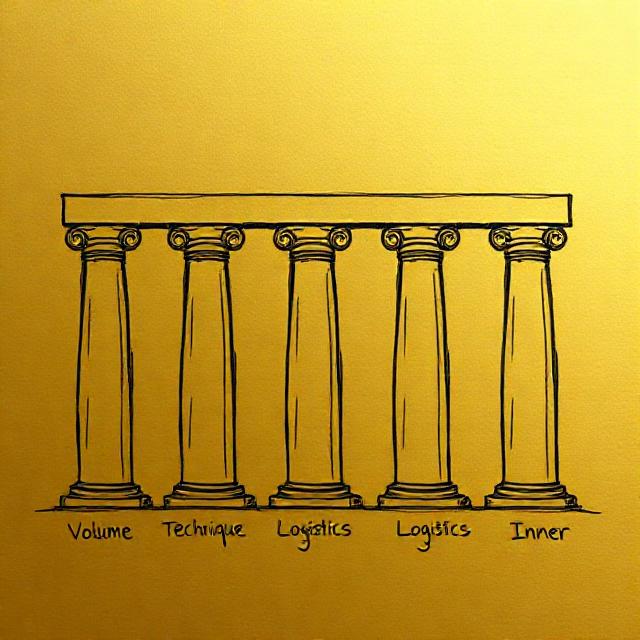
    What does this skillset consist of? This has caused much confusion in the community because unfocused effort is both wasted and, many times, counterproductive. We aim to answer this question precisely. The Daygame skillset is comprised by five pillars:

    All of these are equally important and equally relevant for our success in the field. A Player needs all of them for consistent results. One won’t cut it, two won’t cut it. It is all or nothing. Seduction is “winner takes all” because of the laws of hypergamy. If we want to get precise, as a heuristic, I would say that missing one makes it exponentially harder, and missing two makes it nearly impossible to get a Daygame lay. This begs a deeper question: what is Daygame actually aiming at?


    Sustainable Success

    A discussion is required here. Sure, the skillset exists, but what does success mean? Is it unlimited access to quality girls for life? That would be ideal, but it is unrealistic. Instead, what we aim for is “sustainable success”, meaning success that is repeatable, but not purely mechanical or endlessly scalable. Let’s understand this with an example. We all have a chode friend. He goes out one day, gets drunk, finds another drunk girl, and scores a one-night stand. Nice, success! But… something is missing. 

    It is replicability; what he did is not systematised and cannot be repeated with statistical confidence. Our friend in question is susceptible to the whims of luck both in acquisition (finding his one-night stand) and his retention (maintaining and keeping the girl).

    Daygame is not like that. Daygame has a clear structure and input/output guidelines. Eventually, a seasoned player knows how much effort he needs to put in to find a girl, whether measured in number of sets (e.g., 30–60) or time spent (e.g., 1–2 weeks). This makes all the difference from the lucky one-night stand our chode friend got earlier. This is specifically why learning Game is worth it. 

    However, even Daygame is not infinitely repeatable. Because our value is an equation that involves our vibe, we will eventually hit diminishing returns. Opening carries an emotional cost; it is a catabolic action, and inevitably, our vibe diminishes to a point where nothing is achievable except taking a break and focusing on other areas of life for a bit. This predictability, but not infinite scalability, is precisely what sustainable success means. It is the extent we can push the limits while still staying “human”. Let us now analyze each category.


    Volume

    As a definition, volume is self-explanatory. It is the amount of infield work. The realistic unit of measurement is “sets”. Anything after opening (texts, dates, etc.) is calibrated to the girl and distorts the purpose.

    Its function is purely probabilistic. Simply put, we are increasing the sampling size to make results predictable; it is the law of large numbers in action. It is especially pivotal when testing and introducing a new theory. A model change is not measurable in 10 sets, but very measurable in 100 sets for its impact and utility. Hence, your skill and proficiency in Game cannot be guaranteed without that bedrock of volume.

    Calibration

    With that being said, here is the caveat. Do we need a big Volume to get success from Daygame? Absolutely not. With calibration and patience, a trained Daygamer can gauge the probabilities of successful sets pretty accurately. 

    This, however, distorts the purpose of Game. It carries a heavy cost in time (to find such a girl), in learning potential (by definition, you are opening within your comfort zone), and in quality (the higher you go, the more Maybe girls we get). Therefore, a low volume/high calibration strategy is not recommended.

    Additionally, even at advanced stages where players are expected to have reached the limits of calibration, the calibration itself has its own limitations. It is one thing to be able to predict if a girl will be open to being approached or give her number, and a totally different thing to be able to predict if a girl will sleep with you. Calibration can never fully replace infield work


    Value

    Now, if one thing is elusive to define, it is value. Simply put, Value is the abstract collection of traits that make us attractive to the ladies. Canonically, that is its definition. Let us defend this and connect it with the Red Pill definitions of value.

    Red Pill has adopted many economic terms that, at first glance, contradict our definition. We all have heard about “Alpha is a value-giver” or “give value to your community”. My answer: those things wouldn’t exist if they didn’t also increase our chances of getting laid. Sexual and economic value go hand in hand, evolutionary speaking. This is proven by contraposition: any form of value production that doesn’t increase your chances of passing on your genes increases your rival’s.

    Value in Daygame

    We have a working definition, but it is still quite abstract. Especially so when applied to Daygame. If value is anything that girls like, how do we quantify and use it?

    We are lucky because Daygame itself is limited in the scope of its value proposition. By construction, Daygame only cares about specific aspects of Value. This makes things workable. Value defined within the context of Daygame boils down to three categories:

    • Looks: which further breaks down to genetics (height, symmetry, testo, etc.), researchable/planned (fashion), and built (gym).
    • Charismatic: essentially, how we capture the attention and admiration of strangers. It is heavily reliant on education (provide specialised input), wit/vibe (provide intriguing input), and experience (provide applicable input).
    • Archetype: this is an amplification of Value by coherent life choices. Essentially, achieving more than the sum of individual parts. For example, the cowboy archetype is much more than the hat, boots, and horse, because the cowboy lifestyle means so much more. However, when a stranger sees the hat, horse, and boots, they will naturally infer the other traits without requiring demonstration.

    Inner Game

    Inner Game is pretty complex. On the surface, why should there be any need for it? Daygame has a concrete theory and a clear timeline for improvement. Then why do so many people who pick it up fail and abandon it soon after? There is a clear mismatch between progression in reality and progression in theory.

    Inner Game serves as an inner toolkit of the psyche to withstand typical infield pressure. It breaks down into four categories.

    It is the ability to withstand adversity

    Daygame has a brutal learning curve; there is no denying it. The beginner will usually have to withstand hundreds of sets before he finally sees success. It takes a certain personality that can withstand this pressure.

    But even at advanced levels, the issue persists. I remember a day that out of 7 sets, 5 were among the harshest blowouts I had ever gotten, 1 was an instant date with an eight (sadly to nowhere), and 1 was a SDL with a seven. It sounds like success, but out of a 5-hour session, I still had to deal with failure 90% of the time. To nail the point, I remind the community anecdote about Tom Torrero. Supposedly, he had gotten 14 harsh blowouts in a row before the 15th set escalating into an SDL.

    The ability to project your Being into the world

    Seduction just doesn’t work unless you fully believe in it. Deep down, seduction is character and ID-driven. At this deep level, it is impossible to fake things. It is a place where pretending doesn’t protect us, and Ego delusions don’t protect us. A parallel is negotiating a salary with your boss. Much of your success depends on believing you deserve the raise. You have to have your inner world set, so you can project it outwards.

    Humans have evolved to sniff out inconsistencies from a mile away. Girls doubly so, because their genetic descendants rely on her ability to choose a male with good genes. Therefore, it becomes really hard to express Value we don’t truly have. To narrate stories we haven’t really lived. To pass shit-tests only on words. Frame, specifically, is controlled via emotions and non-verbals much more than verbals.

    The ability to reinvent yourself

    Seduction is not a magic pill. It is very grounded in science. Scientifically, there is indeed a type of man who gets laid. There are actually many of those types; there is significant leeway and wiggle room. This is good for us; otherwise, we would have to resort to fatalism.

    However, when starting your journey, you are not any of those yet. You don’t even know which one you will end up being. You will have to break down habits and re-examine everything that you hold dear. Eventually, you will have dug so deep to discover your immovable true core, and this is where your purpose will start to make sense.

    Then we are still not done, you have to consolidate your inner discoveries with your outward persona. What is broken must be rebuilt. This takes courage and experimentation. Not many people have this capacity for self-reflection. It is very, very hard. Every part of your being will be resisting you all the way. But it is possible, and it is worth it.

    The ability to charter your course

    When we are introduced into this community, when we step out of the Matrix, all the orderly delusions of the world break down. This was the one benefit of staying plugged in; it was comfortable, but now it is not anymore. We need to keep going; we cannot stay paralysed without moving. We need to chart a course on uncertain grounds. It feels like walking blindfolded on a tightrope. This is not easy. We have been given agency, and that agency comes with a specific proposition:

    We are free to make choices, total freedom, but we have to learn to accept the consequences of our own actions. 

    Some people can thrive on this; some people need to learn how to thrive. For naturally high agency people, this is the default mode. For the others, they will have to learn to adapt.


    Logistics

    Logistics is usually defined as “having accommodation” in a convenient place. For much of the time, this is enough, but it gets deeper. Logistics is about our high-level plan of seduction. It is the way we structure our choices and the tradeoffs we consciously choose to undertake. Here is an analogy:

    You want to run a marathon. One track goes through a Mesa, which is mostly flat, but isolated. No phone signal, no access to supplies, and hard to get assistance in an emergency. The other track goes between two cities, you will pass through shops, but it also has significant sections with hills, and you will need more energy to undertake them.

    If we are optimizing for speed, the Mesa track is the best choice. It is flat with few distractions. But it provides no leeway; any emergency will significantly endanger your life. This doesn’t make it unviable by itself. For example, you can always hire a team to keep pace with you in a supporting track, or you might be so experienced that you can take the risk. But the whole point is: it has to be a conscious trade-off that you can plan and play off from. 

    Logistics means mapping the area and charting your path knowingly. The advice a newbie should take on the Mesa track is objectively bad. Not because he might not pull it off, but because he cannot plan for it.

    Strategic Daygame

    Back to Daygame now. We can see that some Logistic advice is objectively better than others. For example city-center apartment vs the suburbs. 

    This is good, but what is more important, especially for the beginner, is to know why. For example, a city-center apartment can accommodate a first date lay, while living further might require two. There is a bunch of extra variance introduced from the downtime between the dates, hence city-center beats the suburbs.

    The contrary is also true. If you have a suburban apartment, the fact that you probably need two dates (excluding outliers and high-interest girls) should make you restructure your date plan. This knowledge/ability to deal with logistics is as important as having the city-center apartment itself.


    Technique

    Technique is the learnable/teachable part of Game. If you can explain it, then it is part of Technique. Importantly, this includes calibration.

    Let’s leave calibration aside for now and discuss Daygame Technique. Thankfully, it is really simple. Once we learn how to open, handle a set, and lead through the dating process, there isn’t much else. This is a positive of Daygame, over, let’s say, Social Circle Game, where we need a how-to for handling large groups of people. Pick any Daygame textbook, and you can be done with this part.

    What is certainly less easy to learn is calibration. But… Why is even calibration part of Technique? Plain and simple, we can always explain when we do something based on calibration. Calibration says: “I noticed that, so I adjusted that way”. For example, manners are a form of calibration (cultural form), and there certainly are manuals on manners. The whole point is that calibration is learnable.

    In our case, seduction calibration, is mostly taught infield the hard way. There is simply no substitute for learning and reading signals and body language except hands-on experience. The saving grace is that, albeit hard, there is a clear path to learning Technique: practice, lots of it. 


    Infield or no Infield

    This is where newbies need to be especially careful. When we are talking about learning Daygame, we obviously need to practice. But we do infield work for specifically two goals that we shouldn’t confuse:

    1. To get results
    2. To learn/practice technique.

    Things collapse when number 2 doesn’t directly lead to number 1. This is a big paradox, right?

    As we discussed in the beginning, to be in number 1 mode, we need mastery over all 5 pillars. However, only Technique is directly practiced infield. The other pillars take input from infield practice, but need to be addressed also outside of the field. We cannot solve Inner Game infield, we cannot solve Logistics infield.

    That is why the newbie needs to do enough infield work to practice Technique, but then needs to moderate it to allow work on the other pillars. Throwing yourself into set after set, after some point, won’t help you on its own.

  • Substack, now open

    Substack, now open

    Coffee Daygame now has a substack, here

    Promise to readers: This blog will be maintained and it is the primary base of my writing. The content will be mirrored in Substack.


    Site Map

  • The Daygame Journey or “How to get laid with Daygame”

    The Daygame Journey or “How to get laid with Daygame”

    Clickbait title? You betcha. But this is Coffee Daygame, so we can’t just churn junk. Buckle up for a deep dive into the mechanics of Daygame. From a bird’s eye view, we can categorize all aspects of Daygame into:

    1. Technique
    2. Volume
    3. Value
    4. Inner Game
    5. Logistics

    If you have all 5, you will get laid from Daygame. If not now, maybe in the next 30-50 sets, but you will get laid. Miss one, and maybe you can get some lays here and there. Miss two and you probably won’t get a lay. Did we just prove the brutal learning curve of our beloved discipline?

    To add salt to the wound, Daygame is harsh enough to not reward you with lays until that intermediate phase. We don’t have the advantages of Nightgame with drunk, horny, DTF girls to get “lucky” lays. There is a long road of existential dread before Daygame presents its gifts. Thankfully, those gifts are worth it, so don’t lose hope.


    Stages and Pillars

    When a beginner discovers Daygame, he doesn’t have any Pillars mastered yet. He doesn’t even know they exist! During those first steps, it is blind leading the blind. To discover them, he needs to ask the right questions

    Thankfully, infield experience is enough to make these questions appear at the forefront of his mind. One way or another, he will encounter roadblocks that demand answers. The reality of things is that the deep introspection that Game demands can only be motivated externally. Men refuse to face Ego death without real-world evidence (and even then, some people still refuse to face it). The adversity makes the Man in Game.

    Trouble begins when the Journey doesn’t present those questions that lead to improvement in a nice, digestible way. At each stage of your Journey, only some of those become available for the student to address. Daygame presents problems at a non-uniform pace. We will explore precisely this aspect of the journey. It is a long journey, and this isn’t a flaw but a feature — there are simply too many elements that must be addressed.

    However, to analyze the journey itself, we need a vocabulary to express the psychic interplay. Let us build on Daygame wisdom.


    A model of the Soul

    Before anything, we need a model of the Soul. There is much interplay happening in our brains. We have our goals, but we also have the millions of excuses that come up against those goals. Hence, improvement isn’t a linear path of setting a target and advancing towards there. Instead, what happens is your brain tries to subvert you every step of the way. For a brain that is evolved for survival in the savannah, maintaining coherence and the status quo is much more important.

    These are the roots of the so-called Ego-traps. Game is full of those because it deals with one of the two fundamental aspects of life. The purpose of all organisms, evolutionary speaking, is Survival and Replication. Game is the Replication aspect itself.

    To be able to address the issue of Ego traps, we need to first verbalise the issue. For much of the Daygame community, myself included, a mix of concepts from Jung and Freud has helped. 

    • Self: Call this the id, the true self, or the inner core. It is the very deepest part of your Soul. It can see the world objectively. In terms of winning and losing. In terms of advantages and disadvantages. Dopamine, Serotonin, Oxytocin, and Endorphin: the mechanics are neurochemical. You might reframe your life situation all you want, but your Self knows. It knows your true part in the world, your true value, and all your self-deceptions. 
    • Consciousness: In short, You. I mean, You with a capital Y. The entity reading and parsing this. Your inner monologue. The observable part of your brain. All the thoughts and ambitions that you can verbalise. 
    • Ego: the bridge between the Self and You. If you observe your thoughts, sometimes you will see that they have gone astray. You didn’t skip gym because it was raining, you skipped because your Self doesn’t like gym. It will whisper in your ear ambitions and the plans of the Self. Sometimes it will work for you, sometimes against you. It is the voice that tells you to stand up and fight for yourself; it is also the voice that tells you to go hide and give up. 

    The interplay

    Here is the psychic interplay that happens during your rebirth as a Player. You start with an Ego, that is, your inner image of yourself. That image is both affected by your Consciousness and your Self.

    Every time you practice Daygame and face rejection, your Self registers this as a survival threat. It is a punch in all three relevant neurochemicals: Dopamine (expected reward), Oxytocin (belonging), and Serotonin (status). Your Self won’t just stand there and take it. It will fight back. In practical terms, this interplay makes your Self clash with your Consciousness. This is why your Ego reacts by subverting your thoughts: it gets contradictory signals.

    This will be the state of things until you get results competence. Then your Self will start being on your side. All the chemicals that were withdrawn earlier, are now excreted in abundance from meeting, dating and laying girls. This sounds good in theory, but it is exactly what causes Daygame addiction. Essentially, Daygame becomes the mechanism of all the happy feelings in your life, so you obsessively return to it, because comparatively, everything else in your life is mundane and muted. As you can already tell, this is not healthy either and it is the second (the intermediate) challenge you need to overcome in your development as a Player.

    The last battle is training your Ego itself. So far, the Ego was a tool used by the Self and Consciousness. Not once was the Ego used for its true purpose: stabilizing the relationship between the two. Achieve this, and you can balance impulses (Self) with cognition (Consciousness), this is the true path to happiness. Let us now break everything down from a timeline point of view.


    Beginning and the first glimpses of Inner Game

    You read about this Daygame thing. It sounds a bit weird, but you ain’t got a girl, and you got bored of porn. So you decide to give it a try. You go out to the local shopping street and… your feet stop moving. 

    Welcome to your first step outside the matrix. Before you even utter your first word to the girl, several questions demanding immediate emotional answers erupt in your mind:

    • Are you entitled enough to go and stop a girl?
    • Can you really have a chance with her?
    • Can you trust the process? It mostly comes from internet guys anyway. Your previous life was not great, but at least it was emotionally secure.

    The trick here is that you need emotional answers. Logical ones don’t cut it. It is not enough to know the answer; you need to feel the answer. You need to act congruently with that answer. That’s why Inner Game is so hard.

    These are surface-level symptoms of approach anxiety. They are surface-level because the true cause is low self-esteem. The beginner cannot solve the root cause. We are not yet at the phase of delving that deep into our psyche. Hence, the best we can do is patchwork. Nothing can help you past this stage except the sheer force of will. You will have to rely on mechanical, scripted behaviour just to get yourself moving.

    But why so much internal resistance? Your Self knows the true deal: your value is low, and your life suffers as a result. If your life were already aligned and fulfilling, you wouldn’t be seeking pickup in the first place. It will be a tragedy if these thoughts reach your conscious mind. Your Ego and your Consciousness might not be able to take it. 

    Your Self is actually trying to protect you and keep your worldview intact. If you decide to proceed, you have already made an enemy of your deep identity. This is why almost everyone who becomes good at Game is running from something internal. Even from these early steps, we are going against every part of our identity and character. The emotional energy to move forward is enormous.

    Let’s not get ahead of ourselves. Your problem for now is going to stop a girl without being paralyzed by fear. Your Ego is weaponised against you, so you make all sorts of excuses: “She is walking too fast”,“She looks serious”, “She is out of your league”. This is normal, get used to it.

    The only way forward is to mentally shut down and simply not listen to your inner monologue. Trust the process and plow on with self-discipline. You will walk miles and miles trying to get yourself to approach; some days, you will even fail to open any sets. Eventually, you will manage to get to the next stage.


    Issues → first contact with Inner Game.

    Way forward → self-discipline


    Ok, I can get into set, now what?

    With pure dedication, you can now open sets. But… what do you do in set?

    Here is the first need for Technique. You can wing it and pretend to call it progress, or you can open a book and try to properly address the issue. The number of people who try Daygame and haven’t read Daygame Mastery is alarming. It is the equivalent of trying to do math without knowing the numbers.

    The pitfall of avoiding instructional material is pretty clear. You have been subverted. The saboteurs of your Ego invaded your consciousness. Your Ego has won. It has bullshit you into believing you are making progress. 

    You know about the concept of Game, the Ego cannot hide that part. Instead, it can dress Game in a way to make it morbidly ineffective. It makes you refuse to teach yourself. Here is the metaphor: You want to get ripped. So you enrol in the gym. Half the days, you only go up to the gym door. The other half, you go in and try the bicep machine with your legs instead of your arms. But since you are going to the gym… this is progress!

    The harsh reality is that your Ego is partially right. It has a correct reason to try and deceive you. Even knowing the correct technique won’t achieve anything yet. It will only turn you into an approach machine. The Ego can see that Technique is not enough for results. You only started addressing two of the five categories (Technique and Inner Game), and even those without a hint of competence. 

    Therefore, results are still a distant dream. The Ego can see this. What it cannot see is the life-altering transformations that are still stored in the future. It takes long-term thinking and a work ethic to move forward: You subject yourself to set after set with no realistic hope of achieving anything, but it feeds your future revelations.

    In the beginning, you will be mechanical. You will be clunky, and you will be incongruent. What we try to achieve is planting the seeds for later development. That’s what matters. Daygame technique is not complicated, but it should become second nature. It should pass into the level of unconscious competence. Later on, you will want your thinking horsepower to be dedicated to things such as verbal dexterity and calibration; hence, the model structure has to be automated.


    Issue → learning Technique

    Way forward → Yes, practice until you learn


    Approach Machine

    Finally, you plowed through the first two steps! You can now reward yourself … with even more pain, restlessness, and stress about your direction in life. Harsh, I know — ouch.

    But it is the truth, the prior phases were the kiddie pool. We now enter the hardcore realm of self-improvement. To make progress from now on, we need to start understanding the inner complexities of our souls and human behaviour in general.

    In terms of results, we are still at a low point. You can throw yourself into sets, get rejected 90% of the time, and maybe get a number and a date out of pure luck once a month. This breeds an Ego trap: getting content with too little. 

    The results are bad, but you might be satisfied ending up with a girlfriend or satisfied with a high attrition strategy. You need to resist this. You need to greedily push for a high-efficiency strategy.

    Even if you think the results are acceptable, the pressure you put on yourself is not sustainable. Getting a lay every 100-200 sets (if you are lucky) will strain you emotionally in the long run. Instead, we need to actually do some serious inner work. Results should be viewed merely as a happy distraction.

    The gift of feedback

    At this point in your Daygame career, you have earned a very special gift. The gift of feedback. Well, kind of. More like the threat of feedback. Because your Self is still not on your side, that causes the uneasy feeling. He doesn’t like the self-whipping. But every piece of feedback can only come from throwing yourself into set after set. 

    The girl is your mirror, as Tom Torrero coined. Her reaction speaks volumes about who you are. You start to become present enough to see this. Cracks of reality here and there. These are little moments of shining light. Patterns start to emerge. This is the channel of the true “nature” of male-to-female dynamics. You can tap into it!

    However, your Self is deeply threatened by this. Your conscious mental models are starting to become strong enough to override its emotional control of you. As a result, your Ego from this point onward will intensify its attacks. It will try to mislead you into wrong explanations, defeatism, and avoidance. 

    But you now have a new weapon. You opened the gates of Hell, and your Consciousness can see the ugly picture. It can see reality, unfiltered by external Frames and your Ego itself. This is a pure and rare gift. If you think your sets for long enough, you might start thinking, did all my self-deceptions hold true? Did they really explain the interaction? The answer is no. You can see past your own Ego!

    From this point, it is not blind leading the blind. You have seen infield reactions. You have gone on some dates. You have caught the attraction and the desire in the girl’s eyes. Maybe those internet guys weren’t bullshitting after all. This is the path forward.

    Strategic approaching, discovering Value

    It is a good time to stop the mass approaching. Mass in the sense of non-intentional. The goal has shifted to feedback gathering and understanding. Maintain enough approach numbers to get “true input”, but your work now is outside of the field. Here is what your thought process will look like:

    • Well, I am following the technique to the letter, but why haven’t I gotten laid?
    • Entitlement was what I was lacking in the beginning, but going into set and acting like dickhead doesn’t have much of an effect.
    • Why am I even on this journey? Why does achieving in Game feel so precious and special?

    The elephant in the room is graspable. You can see the central issue: your Value. No amount of Technique or Volume can make up for low Value. 

    The delusions of Game you had in the beginning will be dispersed. Daygame is not a simple affair. It is not a party trick; it is not something you can turn on and off. And most importantly: it is not a hack to pussy paradise. 

    Instead, fundamental questions about yourself have to be addressed: Who are you, and what do you want in life? More importantly, why should life give you anything? This is exactly how you can start mentally monitoring your Value.

    The gates of the Abyss

    With this laid bare, all the little lies you were telling yourself in your chode life are crumbling down. You are naked in a hostile world. This is where true introspection will begin. Expect many dark nights of the soul and massive amounts of incongruency and cognitive dissonance

    You have had a glimpse of what is possible. But you are miles and miles away from that life. You are consciously dissatisfied with your life and constantly pushing forward to change everything about you. Ideologically and behaviourally, the change is massive. This is a very vulnerable spot.

    All your friends, family, and acquaintances now become your enemies. They sense you want to bring change. Consciously or unconsciously, they will try to stop you. For people entrenched in the matrix, change is a disturbance and an enemy. You have to battle their Ego now, as well as your Ego. From this point onwards, if you want to continue in this journey, you are alone. This means you take all responsibility for yourself. No more petty lies. Your life is yours, the actions and the responsibilities. 

    Congratulations, this is your first step towards mental freedom. It is gloomy, but it is also liberating.


    Issue → You have reached rock bottom. The whole world is piling on you. 

    Way forward → uncover true signals, uncover Nature


    The truth

    Keep at it for long enough, and you will start mapping out your soul. That’s the deeper emotional level. The truth is that making it in Daygame is so hard that no one makes it without running from a deep, dark secret. This is the real motivation to keep throwing yourself at sets.

    When you can see your actions clearly, with true objective lenses, you will be able to see this deep, dark secret. The emotional prison of your life that had cast you away from your previous path. For example, Krauser had a divorce and a morbid fear of a future alone. For me, it was a self-obsessed and manipulative mother and an early exposure to traveling abroad (alien culture). My mental concepts of the world were not holding up.

    At this point, if you ask me, stop. Seriously, just stop. You have done enough infield work. The battle is in your own head now. You have to turn inwards and face those demons. At least partially. You are not at the destination yet, but you have hit a critical point. No more outer improvement can be achieved without inner improvement first.

    If you don’t feel comfortable and happy with your own skin, how will she like you? This question summarizes everything. This is your guiding light. The goal now is to raise your value and your inner game.


    Issue → The abyss of the Soul awaits

    Way forward → face your inner demons. Conquer Inner Game


    First success and being an Intermediate

    If you keep at it even longer, you will pass the previous stage, and you will see your first true results. For me, it was 3 lays in 60 sets in the span of three weeks (sets 820 to 880). 

    You learn seduction from successes, not from failures: “I didn’t fail, I just found a way that doesn’t work.” This is not.

    You develop true confidence by successes, not from failures. Your Self knows, and your Self is not satisfied without real-world evidence. 

    This is where the road to mastery begins. However, to even reach this first success, you have to pass four phases of Ego-breaking, soul-shattering pain, and introspection. If you made it to this point, you are an Intermediate. Revel in it, you deserve it.

    You are still far away from consistency and true happiness, but you have made your life very much better. The first glimpses of sexual freedom are here. Don’t underplay this. If you reached this phase, you won’t have to worry about sexual scarcity ever again. Access to pussy becomes a question of quality and quantity. You will always have access to a girl one way or another. Any dry spells are induced by your laziness rather than your ability.

    State of affairs

    In terms of inner game, you have won half the battle, breaking your old chains. There is still half way to go, though. You will dismiss and resist it, but you need to rebuild your soul. You broke your artificial boundaries, but you still don’t know your true limits, likes, and dislikes. Once you lift the artificial limitation from your life, the emotional picture is quite different. 

    Just because you cannot yet see them, it doesn’t mean you don’t have biological boundaries; this is your true nature. You need to explore and map it out. More importantly, you need to accept your own nature. All these goals you saw on the internet, lay counts, eurojaunts, fast escalation, they are possible! But which ones do you really like and want to pursue? And for how long? You will have to abandon external advice and go by feeling. Now you can start trusting your feelings; they are not hampered by scarcity, so they are true.

    Ever the dickhead however, you will revel at this stage. There is not enough adversity to make you dig deeper and find the Inner Game gap we discussed. You will ignore Inner Game and do what you have been doing. So, we have to be realistic. The only improvements you can achieve are infield now, at least let’s make the most of it. Your focus should be:

    • Perfecting the date model
    • Faster escalation
    • Improving your logistics
    • Improving volume (of lays)

    Issue → First summit conquered

    Way forward → Master Technique, Logistics, and skyrocket your results


    At the top of the mountain… even more mountains

    The next adversity you will face is results inconsistency. As always, this is the symptom, not the cause. To progress to the next step, you need to find and dig out the root. 

    As always, the root lies in your Inner Game, so this is the focus again. But how will you uncover the need for this?

    You will have weeks when you are slaying it. Dates every day, maybe your first idate kiss close. Maybe a SDL, or a very fast lay. Where things go wrong is your own dissatisfaction with your success. The successes don’t excite you anymore; they are not enough. You went from true scarcity to artificial scarcity.

    No, you are not delusional, and this is not in your head. You uncovered another truth about the world. Pussy isn’t just pussy. There are gradations and quality in girls. Your results are very much tied to the quality of the girls and are also very inconsistent. 

    After that week of constant dates, you didn’t get another date for two weeks. You start getting anxious. You mentally collapse. You laid two new girls in 30 sets, and the next lay took … God forbid, a full 70 sets to come! You are certified chode again!

    Humorous as it may sound, you face the consequences of bad Inner Game again. You destroyed your mental chains, but you didn’t build anything new. Your pseudo-confidence now is built on paper cards. A blow of the wind and you relapse. 

    Since you are still getting lays, you will deny this for a long time. Who cares if you are laying 6s if they don’t give you much shit and they make up good stories. Well… your Self cares. The eye of truth deep in your soul.

    The way forward is again, a break from Daygame. Your mission now is out of the field. Your mission now is to integrate Game into your reality. Game obsession and artificial scarcity, the hint of disgust you get from laying a six, are equally as bad as the true scarcity you had at the beginning. Your goals are as follows:

    • Come to peace with the variance of Daygame. Your value is not tied to the whims of the girls.
    • Obsession with Game does not equal happiness in life. You have done the hard work. Game needs to be dialled down a notch to be a sustainable (psychological) endeavour.
    • Get fun out of Daygame. Do some relationships, learn to enjoy the girls for the girls, not for the +1 text.

    You will also have to address your Value again. You raised your level to tap slags here and there, but for consistency, you need excellence. Excellence is not half-assing it. 

    You will dig deep and obsess about perfecting your fashion, knowledge, strengthen your worldview, and raise your value in any way you can find. Quality pussy demands excellence, and we have to find our own excellence if we want some.


    Issues → Shallow inner foundations

    Way forward → Perfection and mastery


    Freedom

    We now reach the entrance to advanced territory. Your Game is ID and Character-based. It is also Calibration-based, not rigid Technique. 

    From your obsessive results hunting, you have caught glimpses of the ultra-fast seduction of Daygame. Lays and stories that defy reality so much, people will hardly believe you. The 1-hour SDL, the 20-minute kiss close, the bounceback straight to home. You can now pull them off.

    The results and your happiness are a function of your directed effort and your conscious planning rather than the whims of luck. You’re thinking seduction long-term. 

    Go on, my friend, the world is your oyster. You can now develop new Daygame theory, and if you are like me, even write a book to share it.

  • Empathy: Charting Course in Daygame

    Empathy: Charting Course in Daygame

    “Empathy is good for Game” sounds a lot like a truism, correct? It sounds good, so it must be true. We can spit out more statements like this:

    • Having big biceps is good for Game.
    • Having a six-figure job is good for Game.

    Well, at some point, we need to switch our viewpoint from expansive (i.e., more is good) to a restricted viewpoint (i.e., the minimum requirements). At some point, there must be a meaningful distinction. Players have gotten lays without big biceps and without big wallets, but the same can’t be claimed about Empathy.

    Don’t take this lightly. This is the top-down perspective on our biases. What we are discussing is exactly how to audit ideas and advice. This is rarely discussed in the manosphere, and that is why there is so much debate over what Game is. Different angles of analysis lead to different conclusions, even with the same inputs. For example, an expansive viewpoint leads to the run-of-the-mill “raise your value” guy. Do gym, work on your own business, do approaches on schedule, etc. But are people who follow such a schedule with Spartan discipline truly happy? I think not. 

    The key here is the direction of our analysis: it becomes diluted when we switch the question from “what do I need to get laid?” (at minimum) to the question “will this help me get laid?”. The first question has only a few answers, while the latter can be as open as “owning a goat” being a legit answer.

    The plan to get laid

    Falsifiability, the cornerstone of Science

    The keyword here is falsifiability. Can your statement be wrong? For example, can a goat help you get laid? … Well, it depends on how you use it:

    • If you are a farmer in the 1500s, a goat might be the equivalent of a status symbol as a Lambo.
    • In the 2000s, you might use it for swag points at your villa parties.
    • Most likely, owning a goat will not help your Game.

    There are arguments for both sides and this ambiguity is confusing. As is, we cannot falsify any of the correlations between goats and Game. The original question has to be reformulated. Here is the falsifiable version, try answering: Do I need to own a goat to get laid?

    This concept of reformulating questions to obtain better answers is not new. In fact, it is the cornerstone of Science. And what I mean here is true Science, true Science with capital S, not 21st century Academia.


    The reason why falsifiability is so important is that it allows you to make a hypothesis. The hypothesis can then be tested experimentally and empirically. Take the following statement, for example: Does Bigfoot exist? From a Scientific viewpoint, this is not a question. Bigfoot does not exist, period. Well, why?

    Assume now you hold the prior worldview that Bigfoot exists. Well, how do we test it? We can search in the forest, behind a tree, and under the table, and not find him. But this is not enough evidence to falsify the statement. For all we know, based on our prior assumption, Bigfoot might still exist somewhere else. Unless we search the entire Earth, we could never falsify the statement.

    Where?

    Assume instead, you hold the opinion that Bigfoot does not exist. This is a falsifiable statement. The moment you find him, maybe behind in the closet or under the bed, we can revise our opinion and correct it. This is the essence of deduction. A statement is as useful as its deductive value. But if it cannot be falsified, then we cannot get any deductive value from it.


    Game as Epistemology

    This thought process is crucial for your development in Game. As Krauser pointed out, we Players, know much more than scientists. Simply because we have access to infield data. We can make a hypothesis and then go test it infield to get real-world feedback. Sociologists and Psychologists cannot do that. That first part, however, the making a hypothesis part, is as crucial as the second part, the infield testing. If we cannot order our thoughts, then our infield experiences won’t help us resolve our questions. They might even lead you to wrong conclusions, turning a well-meaning process into pure quackery.

    Don’t take this lightly. Like poker, Game is subject to high amounts of luck and variance. Distinguishing rules from noise is all the more difficult. Sadly, unlike poker, we also don’t have a fixed statistical population (the deck of cards) to build theories upon. That is why debate still rages over principles and concepts, even if Game has already existed for 20 years. Distinguishing value from garbage is all the more important. Falsifiability and a restricted worldview are the foundational concepts of Seduction Theory.


    Empathy

    One of the concepts that is indeed foundational for Game is Empathy. Empathy is the basis of calibration. Let’s unpack it, a common definition is as follows:

    Empathy is often defined as the capacity to recognize how someone else sees a situation, to grasp and emotionally resonate with their experience, and to respond to it in a meaningful way.

    Therefore, Empathy is understanding. Understanding the thought patterns and feelings of the other person. It is the baseline of strategy. When Otto von Bismarck outplayed the fuck out of Europe to create a strong German empire, he had Empathy. When a chess Grandmaster can essentially read your mind and outplay you, this is Empathy.

    Empathy is about strategy and war. It is an entirely male concept. However, as with most male concepts, Empathy has been hijacked by Modernity. The concept has been diluted, even turned into a female concept. The average person cannot understand Empathy because they confuse it with Sympathy. Sympathy is copying the feelings of another being. It is entirely a female concept. Again, here is a definition:

    Sympathy refers to noticing and comprehending another being’s hardship or need, and feeling moved to respond to that situation.

    When we devise a trap to catch an antelope, we do this by thinking as the antelope does. We study its behavior patterns and we hijack them at the crucial moment. This is Empathy; it is male in nature. In contrast, when you see the struggling antelope in its last moments, and we start crying for its misfortune, totally forgetting your empty belly, this is Sympathy. You feel what it feels; it is female in nature. If males had evolved for sympathy, the entire village would be starving. Empathy doesn’t need sympathy. Bismarck had Empathy, but he didn’t give a fuck about the feelings of his enemies. He could differentiate strategy from everything else. Strategy demands understanding in the abstract. 


    Game and Empathy

    Empathy is the basis of calibration. When we are calibrated,  we acknowledge all the unwritten social rules and the cues from the girl. In particular, we don’t passively acknowledge them. We act on them, we bend them to our will. For example, imposing the Seduction frame or covertly escalating: this is correct leadership in the eyes of the girl. You are on an adventure, but to everyone else, nothing appears out of the ordinary. Specifically, that adventure is tailored to her. To her feelings and her character. Multilevel Empathy in action.

    Now, in one of the most blatant crimes of modern psychology and therapy: convincing men they need Sympathy. Seduction doesn’t work like that. With sympathy as baseline, we have the following scenario: We mentally acknowledge the girl’s hesitation/excitement, mixed feelings at the first date… then, decide to just stand there and emote with her. No, no, no, we take action and lead. The whole purpose of calibration is so we can lead efficiently and effectively.


    History and Empathy

    One of the heavyweight contenders as teachers of Empathy is studying history. For the simple reason that most behavior is affected by culture. Most of the culture itself is an outcome of history. The adversity that society has lived through the ages has been imprinted on its Soul. Studying critical history reveals this.

    The difficulty here is finding good historians. Let us use Carroll Quigley as a case study. In my opinion, the most fascinating historian of the last century. In his books, history is not expressed through stories alone. History is expressed through long-term strategies of nations, people, or civilizations. How these manifested and clashed over centuries. Here are some insights derived from his work [Tragedy and Hope]:


    The West benefited from the Dark Ages by separating the concepts of “society” from “state”. During the Dark Ages, states clearly didn’t exist, but society did survive. This led to the conclusion that the state has to serve society. Religion and the judiciary are separated from the government. The government itself became a tool of society and not society as a servant to the state. 

    Obvious as it may sound, Greek philosophy and statesmanship that dominated the worldview were up for a totalitarian (albeit not necessarily authoritarian) state. Read Plato’s Utopia for example. This distinction singlehandedly explains the difference in mentalities between Eastern Europe (with no Dark Ages) and the West. It is expressed most clearly in the American Constitution.


    The UK was effectively a plutocracy. Simply by eliminating the salaries of government officials. These officials needed an independent income. Running for office was reserved only for the rich. Essentially, turning the country into a plutocracy.


    Three major civilizations collapsed during the 20th century, and the chaos that ensued in the aftermath. Pre communist China, Imperialist Japan, and the Islamic Ottoman Empire. Their modern versions are a Westernized, dysfunctional caricature. This has created much confusion in cultural mixing and interpretation.


    The seven revolutions that made the West free and democratic, just because they were imported by other civilizations in a different order, they made those civilizations authoritarian and undemocratic. Massively so. Essentially, countries decided to sacrifice their own population for access to Western goods and technologies. As can be evidently seen in the USSR’s 5-year plans and China’s Great Leap Forward. The aftermaths are still visible to this day. Enjoy:

  • Online coaching open… for free !

    Online coaching open… for free !

    This will last based on my time availability, but I can probably keep this up for the month of November (2025).

    I maintain the right to select students, so right a letter of introduction with the following:

    • A short bio of yourself mostly focused on Daygame experience.
    • What you want to discuss.

    Depending what you want to discuss it would be good to have the following:

    • Technique: some representative infields of yours
    • Fashion: some picture of you and/or your wardrobe
    • Inner game: an explanation in the introduction letter above

    Simple things that can be answered via email will be answered with that, through email. Otherwise we will arrange a call. I will keep my camera closed, you can do whatever you want. Expect Eastern European time zone.

    Reach via email, my contact form here or through X


    Site Map

  • Appreciate Game: A Perspective on Daygame Results and Stats

    Appreciate Game: A Perspective on Daygame Results and Stats

    It is easy to get lost and underestimate how much value Game adds to your life. Getting control of your love life is one of the deepest male pain points. It matters, or should matter to every man as a first priority, even beyond other areas of life such as wealth or gym. Honestly, ask yourself: if your fundamental core on how to connect with the opposite sex is rotten, how will you enjoy your millions or your biceps?

    Predictably, the narrative in public discourse is the exact opposite of reality, i.e., about how much success everyone supposedly gets. It is even worse online, where success is abundant and lays are 10 a penny. Even the dwarf with one ear and 3 teeth can get laid online, so how can you not? Horseshit of the highest order of course. It just distorts the idea of what success looks like. With the result that new Players don’t know what is enough and can’t accurately measure their progress.

    But destroying this misconception: “sex is everywhere, and you have been missing out”  is among the most fundamental Inner Game leaps. The reality is, yes, sex does happen out there. And a lot of it. It is for Women, Alphas, and Naturals. These are the three categories that get easy sex. That is the so-called Secret Society. If you are not getting consistent action in your life so far, you are not in this category. This is you, and at least 99% of men. Don’t sweat over it, blame nature. Therefore, welcome to Deep Bottom, where sex is indeed scarce. Game is our only ticket out of that world.

    Making it in Game is a precious achievement, because getting any control of your sex life, for you, who wasn’t born an Alpha or a Natural, is something that takes work and effort. And it will never be easy; we are literally going against nature’s plan.


    How much sex is fictional?

    To appreciate the value Game brings to your life, it is best to think by contrast. The first step in dispelling the myth of infinite sex is putting it into perspective with numbers. Let’s do rough statistics to estimate this. We only need to be approximately correct and estimate within order of magnitude to get the picture.

    Estimation 1

    The first calculation comes from Krauser. The quoted article provides the methodology we will use.

    As of 2025, Gen Z (ages 16-30) is about 25% of the population globally. The proportion is even less in the West because of the collapsing fertility rates, but we will go with this number simply to create an upper bound. About half of them are girls and half are guys. Hence, 12.5% of an average country can be assumed to be sexually available females in their prime. 

    According to EU data, about half the population is overweight and obese. Let us assume 50% of girls in Gen Z are within normal weight limits (and this already doesn’t match my empirical evidence). Therefore, from a starting point of 12.5%, only half, let’s say 7% are not fat.. For all we know, she might be missing a tooth, but we will roll with it if she is thin.

    We will now go with Krauser and assume that girls accumulate 1 lay per year on average. Half of those lays are flings, and half of them are within relationships. To put this in perspective, this means that each girl will accumulate 24 lifetime lays for the fertile years of 16-40. This already overshoots sex surveys, keeping it consistent with our upper bound approach. In short, for any given year, half of our 7% population will be served in relationships, and the other half will be available for casual sex. Therefore, 3.5% of the population of women is hot enough and available for adventure sex.

    Now, let us define Player success. A Player can accumulate multiple lays per year, but let us say he needs at least 5 to be worthy of the name (that number is intentionally low). Let’s take it one step further and assume no Players get more than 5 lays. Each gets exactly 5. That means, the whole adventure sex market is cannibalized by 0.7% of men, as 3.5%/5 = 0.7%.

    Therefore, any given country cannot sustain more than 0.7% of men being Players. It is not about skill at this point; it is about how much casual sex women can supply the market.  And remember, we significantly overestimated. The real number is much, much smaller.


    Estimation 2

    This idea comes from the book “Sex and Rank” by Sergei Morozov.  It attempts to estimate sexual encounters based on condom sales.

    Let’s take Europe. Europe has a population of 450 million as of 2024, with 376 (or 84%) of those above age 18. This nets 188 million sexually active males.

    According to the internet in 2024, there were 3.9 billion condoms sold. Condom usage varies widely across studies, but most seem to agree that at minimum 50% of people use condoms. Let us use this minimum, and assume only half of sex happens with a condom on. Since we had 3.9 billion condoms sold in Europe, this nets an estimate of 7.8 billion sexual encounters. Dividing by the number of males… then, each male gets an allowance of 41 sexual encounters for that year.

    That 41 sounds like a high number, but most sex happens within relationships. Let us try to estimate this. Relationships vary from “sex every single day” to the dreaded “sexless marriage”. We will make the executive decision and assume the average relationship has 2 sexual encounters per week. 

    In the course of a year, that relationship eats up… 52 weeks x 2… 104 sexual encounters. This is about 2.5 times the male sexual allowance, which was 41. Let us be lenient and assume that for every couple out there, there is a man who is left with zero for that year.

    The question, therefore, becomes… how many couples are there? Europe estimates have this at 45%. Since each couple consumes twice the Male’s yearly sex allowance, 45% of couples account for 90% of total sex. It also means that there is only 10% of available sex left for the 55% of the remaining men. No wonder adventure sex is so difficult.


    The work required to get a lay

    If people are shocked by the previous section, I remind the audience that genetic studies estimate only 14-30% of men reproduced, ever. Reproducing can mean as little as sticking your dick in a girl only once in your lifetime. Technically, by our estimations, the modern world certainly outperforms prehistory.

    We return to Daygame. Authors (Krauser and Bodi) have written plenty about why 1 girl a month from Game is a lot, and why 2 girls a month is really a lot. I agree. Simply from the practical side of things. Every Daygame lay needs 30-60 approaches for even the best of us. And that is when our vibe is on point. Just how much can you be on the streets without turning into a soulless approach machine?

    Earlier in the year, it took me 70 sets and 16 dates to get a lay. The 16 dates of course are an outlier, but the 70 approaches are not (… not that much). This happened over 1 month with a lazy work rate and life commitments in the background.  Assuming that is an average experience to get a lay …how many copies of this rollercoaster can you emotionally handle compressed in a month to get multiple lays? 

    That is why, as Daygamers, we have periods of multiple lays in bursts and periods of cooling down and approach revulsion. High lay counts in small periods of time (for example, 3 lays per month) are not sustainable over the long run. The work is just too much. In particular, the initial rush aside, how much happiness do people get from a one-and-done situation? Or even a fuckbuddy situation. Here is where you need to put your Ego aside, and decide if you are gonna live your life aimed at hedonism and impressing people on the internet, or live the life based on your body’s needs. Sure, go wild for some time, but when that ends, honestly ask yourself, how much do you value meaningless sex just for the dopamine spike? 

    I personally always have a better time in LTRs. My limit was 3 LTRs simultaneously; I could even slot girls in and out of LTRs as I wanted. This is true freedom and control of love life without racking up 500 notches. This concept has been immortalised by John Bodi as follows:

    • Q: “How much would you pay for two guaranteed 7s every year for the rest of your life ?”
    • A: “My entire bank account and my mother’s house.”

    We have it better in Daygame

    In Daygame, we maintain multiple advantages over other forms of Game. For all intents and purposes, we have better flexibility in navigating girls for our needs. Let us put this into perspective, Daygame is:

    • Highly mobile, or location independent
    • High novelty, as we can meet different nationalities and types of girls. The club and online demographics are much more limited.
    • Very fast and with low maintenance post lay.
    • Better control over the quality of the girls we meet. And I mean mental qualities, not only beauty.

    Take a Nightgamer. To get 3-4 lays a month, he has to go to the club 8-12 times. This is assuming a high close rate of one lay per 2-3 nights out. Can you go consistently out that many times, maintain your A game, and not destroy the rest of your life? How many of those girls are quality and not brainless and boring?

    For a Social Game Player: Lead acquisition is out of your control; you don’t know when girls will fall into your circle. On top, seduction is slow, and good luck managing LTRs and fuckbudies in the same circle afterwards. One mistake and the whole thing blows up in your face. 

    For Online Game, I can make an exception in the work rate. Lays do happen very fast there… but how many of those girls do you respect as human beings and not as pieces of meat? Also, there is a very high chance you will underperform your SMV because hypergamy is truly let loose there. Go fuck 100 sluts, and you might actually end up more broken than when you started.


    Bottom line

    The reality is the one in front of your eyes. The reality is not the experiences and the stories of other Players. And more importantly, the reality is not on the internet. If you find it hard to get a lay, it is because it is indeed hard to get a lay.  This is fair, this is the world, and this is reality for you specifically, with your current SMV, and the amount of investment you want to give Game right now. You are not missing out, and there are no shortcuts. We all work hard for our lays. Eventually, and with skill, the work/benefit balance is to our advantage, but there is still work that must be done if we want results.

    A few quality lays can entirely transform your life. Game is worth it. The infamous 1000 sets of hell in Daygame are worth it. Very few Players claim more than 10 lays in those 1000, and that is okay. For me specifically, it was 8, and 6 of those happened in the last 200 sets. Because my life entirely changed. It didn’t take 100 lays for it; it took 8. Every lay after that was out of choice, for novelty and limit testing. It wasn’t a necessity.

    As a non-Alpha or Natural, life had decided for you to be either hard or impossible to get laid. Breaking out of this is a massive achievement. You qualify for that achievement from “just” getting a handful of lays: you already outperformed your nature, good job! Going one step further and controlling your love life, with options and power to manage your relationships and LTRs, is so far out of nature’s plans for you. It is truly getting away with it.


    Statistics:

    Appreciate Game
    ————————

    Learning Stage stats
    Advanced Daygame stats
    2025 Daygame stat
    s

  • A Date Model for Fast Escalation | Daygame

    A Date Model for Fast Escalation | Daygame

    Finally, we arrive at the holy grail of Daygame. The opportunity for ultra-fast escalation. Essentially, turning the street into a daylight club for the purposes of seduction. Before we delve into the analysis, we will discuss a few disclaimers.


    Mentality

    It is true, a Same Day Lay or a 2-hour date lay is the ultimate expression of your seduction skills. However, it is not a sustainable goal; you cannot just go out and demand the universe to give you a girl who will be in your bed in 2 hours. The whole process is more luck than skill, albeit the “skill” is a hard prerequisite. This metaphor explains the situation.Imagine you are a mountain climber, but you are currently broke and stuck in your boring job. One day, somebody offers you a free trip to Tibet to climb mt. Everest. Everything is paid for and set up for you. Amazing offer, right? Well, depends on whether you can actually climb Everest or not. If you cannot, this is an express offer to an early grave. 

    This is the correct mentality for fast escalation. You cannot and should not expect the universe to give you such opportunities, but when they come, you should take advantage of them, provided that the skill is there.

    Building on the point above is the fact that fast escalation depends on the girl more than you. It is more that she allows you to escalate her fast than something you do, trigger, or induce in her. In fact, most of the girls won’t be up for a fast lay. If you can sniff this early, then a slower dating structure is more appropriate. Plenty of times, I had girls up for it, but failed on the most important step of the seduction, actually getting the lay. This was because girls were ok with fooling around and feeling the excitement of the seduction dance, but even from the beginning, they were a No in the question of sex or no sex

    Most of the time, we, as Players, cannot know if the girl is up for sex unless we reach the point of asking the question. Sometimes, the only thing we can do is roll the dice and hope for a favourable result. This even gets mandatory when we are pressured from other factors to escalate fast, for example, time constraints. Understand and accept this, fast escalation is like a firework. The fuse goes off, and it gains altitude quickly. Sometimes it will climax into a spectacle, and sometimes it will fail to ignite and fall on the ground.

    Finally, nearly categorically, the speed of seduction is inversely proportional to the hotness of the girl. There is an exception for Western girls because … feminism and materialism made them more open to it – don’t bitch about this, it’s to our advantage as Players. Nearly all my fast lays were with 7s and below, and all of the 8s and above took more than one date. There was only one Australian girl, who most people who saw her picture would rate as a 9, and that was a 1.30 hour lay. For this to happen, I was 1) really lucky, 2) her type, and 3) it was a one-and-done.


    Calibration and Amber lights

    Calibration is the foundation of advanced Game. Why? Think about it… what is the best model for girl X? Well, whatever is tailored to girl X based on her character, ambitions, and life experience. At the end of the day, some people get action by putting a leash around their necks and letting the girl parade them on the street like dogs. 

    Hence, what is calibration? It is an approximation of this perfect date model for girl X. On top of that, what makes “perfect calibration” deviate from the imaginary “perfect model” is quite easy to point out. It is 1) information imbalance, 2) the Player’s character and ID (i.e., you wouldn’t put a leash around your neck … right ?) and 3) innate girl’s preferences (for some girls, the “perfect model” is don’t even try). This is Calibration spelled clearly. By defining it, now you can strive for it.

    Disclaimer: This is applied calibration. A practical version of the inner workings of the concept. It doesn’t invalidate our other theoretical definition of it. In fact, they converge.

    The discussion now turns to Amber lights. People prefer Green lights – when a girl gives some signal, it is ok to escalate – but the reality of things is that the faster you push things, the amount of hints you will get tends to be big old zero. This is a feature; she has to test you. And if we are going fast, she has to test you even more.

    I remember a date I had with a Japanese girl, after about 1 hour, it was time for the kiss. I told her I wanted to kiss her, and she sat silent, staring at the distance for 10-15 seconds, not moving, not giving any hint, not saying anything. At that point, I leaned in, gauged her reaction, and kissed her… she loved it! This is an example of Amber lights. I guarantee you, those 10 seconds felt like a year, and it requires balls of steel and extreme calibration to break through it.


    Amber light skillset

    Well, there is skill in amber escalation. How do we develop that skill? 

    Crush and burn

    The biggest factor is your willingness to crush and burn. Going too fast for her limits (i.e., over-escalating), of course, is a minus in the eyes of the girl. But it is not the worst thing that could happen. If we are doing a half-decent job at the initial approach, the girl should get the hint of what dating you means. Daygame is simply designed to communicate that this is fast-paced adventure dating. With this in mind, it is actually more uncalibrated and incongruent to not escalate than to escalate faster.

    Overselling

    The second idea revolves around your confidence in your understanding of the dating process. The key point here is to “not oversell”. 

    Imagine you have to sell a shirt. You talk to the customer about the material, the cut, and maybe the collar. You can go one step further and discuss the color and how it matches the customer’s complexion, but beyond that… what do you say? Do you start discussing how each individual thread has been sewn? Fuck no, you just ask the customer whether he wanna buy or not. This is the same mindset as escalation. The moment you keep displaying value and get nothing in return, it works against you. 

    To do this effectively, you need to have an accurate idea of your value display. If you express too much, then you need to escalate to capitalize on it. Strategically speaking, when we gain a small advantage, we advance. If she doesn’t reciprocate, then maybe she is a time-waster, you have to start assessing this scenario.

    Probing

    Finally, the golden bullet is what is called “Probing”. Probing means that you send a small signal. But not for the signal itself; instead, you are trying to assess the state of the girl. For example, you want to know how comfortable she is with physical intimacy. Find an excuse to ask for her hand and assess how she reacts to the touch. Think about the following:

    • “How willingly did she give you her hand?”
    • “Did she pull out immediately?”
    • ”Did she have a smile?“

    The goal is to gather information, not to escalate. Experience and probes can allow you to be a literal mind reader. 

    To be fair, the damsels are really impressed by this. Not uncommonly, they even verbalize this. But once you learn to probe and read signals, it’s not magic. Eventually, the situation turns on its head. To me, it’s more weird how unaware they are of the signals they give. 


    Re-structuring the dating process

    Traditional Daygame literature has a dating structure of 2-3 venues, compartmentalised with different aspects of seduction in each. The first one is for getting to know each other, the second is for light escalation, and the last is for heavy escalation. Well, it works; it is the layman’s method. We will simplify it:

    Getting to know each other → Kiss → Bounceback

    Why these three specific aspects in the model? It is because this is the bare minimum of seduction. You just can’t go without those. I personally do 1 venue (a coffee) and then some prolonged walk to the taxi or to my place. Of course, adjust it based on your logistics.

    Getting to know each other

    Getting to know each other is a prerequisite. It is not socially calibrated to escalate before that. This takes from 15 minutes to one hour, depending on the girl. This is where you showcase your life (and value) and let her do the same. It is also the basis for further calibration along the process.

    Kiss

    Escalating to the kiss is the second step of the process. This part should be gradual with increasing intimacy up to the kiss (but it depends on the girl as well). Usually, handholding is free after the previous step, then it is about coming closer to each other → to hugging → to kissing. 

    Kissing is the socially accepted way to say this is serious now (in the West, at least). It is an important step based on a shared understanding of culture.

    Bounceback

    Sexual escalation happens after. I prefer to preserve it for the seduction location, but you can start drawing LMR out earlier. As a rule of thumb, I wouldn’t try to bounce back before a make-out.


    Timings

    These numbers come from my experience, so take them as a reference and adjust for your style accordingly.

    • Getting to know each other: 15 minutes to 1 hour. More than one hour, you are certainly dragging things too much.
    • Escalating to a kiss: Immediately to 45 minutes more. If you are getting resistance here, think about either slowing down or having a second date.
    • Escalating to bounce back: around 1.30 to 3.30 hours from the start of the date. 

    A bounceback that takes more than 4-5 hours, in my opinion, is dubious. It is either an outlier and you should proceed only if your calibration says so, or a straight-up time-waster and you should eject. At most extreme, I think I have done 13 dates with no sex. I never got the lay even after all that work. Doing more dates certainly didn’t get me closer to sex; it probably worked against me. 


    The process of Seduction

    We will distinguish two modes of analysis here:

    1. The first level of abstraction: this is how seduction proceeds based on the time limits above.
    2. The actual hands-on seduction: what you live moment by moment.

    Number 1) should be a straight line. If we are talking about fast escalation, you shouldn’t be getting resistance. It should be progressing smoothly within time limits. 

    But… for number 2), the girl is allowed to give you a shitstorm, and you should be thanking her on top of that. Simply put, we are asking life something out of the ordinary, and we should be getting tested out of the ordinary as well. The girl must test your frame, your character, and your seduction skill. She has a right to give you shit tests, and by no means should she make it easy for you. Here is where your Game is truly tested and what makes Daygame so exciting. Every lay is an unlikely scenario full of adversity. 

    PDA culture and kissing

    Some cultures are discouraging of Public Displays of Affection. It is very common in Asia, for example. The girls simply won’t kiss in public or do much of anything except light hand holding. This creates a dilemma for us, the Players. How do we gauge her interest if she won’t kiss simply from public pressure?

    There are only two possible workarounds. We can either try to find spots without many people. Then we can tell if she is not kissing because of social pressure or because she doesn’t fancy us. Or we should calibrate for other signals that signify that the relationship has crossed the kissing barrier. There are no specific pointers for the last part. It is really up to the Player’s calibration. However, it is not uncommon for the first kiss to happen after the bounceback.